Decoding FAFSA Changes: Maximize Federal Student Aid
The FAFSA introduces pivotal reforms impacting federal student aid eligibility and application, necessitating a thorough understanding for all students and families seeking to optimize their financial support for higher education.
Navigating the world of college financing can often feel like deciphering a complex code, and with the imminent overhaul of the Free Application for Federal Student Aid (FAFSA) for the 2025-2026 academic year, understanding these critical updates is more important than ever. This comprehensive guide aims to demystify the upcoming
2025 FAFSA changes, offering a clear, step-by-step approach to help students and families maximize their federal student aid opportunities. From revised eligibility criteria to a streamlined application process, we’ll explore every facet to ensure you’re well-prepared to secure the financial assistance you need.
Understanding the FAFSA Simplification Act
The FAFSA Simplification Act represents a landmark legislative effort to modernize and streamline the federal student aid application process. Enacted to make college more accessible and affordable, this act introduces a series of significant changes that will profoundly impact how students apply for and receive federal financial assistance. These reforms aim to simplify the application, expand eligibility for certain types of aid, and provide a clearer picture of a student’s financial need.
One of the primary goals of the Simplification Act is to reduce the complexity that often deters potential applicants. The previous FAFSA, with its numerous questions and intricate calculations, could be a daunting hurdle for many families. The new legislation seeks to alleviate this burden, making the application more intuitive and less time-consuming. This shift is expected to increase the number of students who successfully complete the FAFSA and, consequently, access the aid they are entitled to.
Key Legislative Goals
- Increased Accessibility: Making the FAFSA easier to complete for all students, especially those from underserved backgrounds.
- Streamlined Process: Reducing the number of questions and integrating direct data exchange with the IRS.
- Expanded Eligibility: Broadening the criteria for Pell Grant recipients and other federal aid programs.
- Greater Transparency: Providing clearer information about financial aid eligibility and availability.
The implications of these legislative goals are far-reaching. For example, the expanded eligibility for Pell Grants means that more low-income students will qualify for this foundational federal grant, which does not need to be repaid. This can significantly reduce the financial burden of higher education, making college a more realistic option for countless individuals. The act also addresses issues of equity, aiming to ensure that aid is distributed fairly and effectively to those who need it most.
In essence, the FAFSA Simplification Act is designed to be a game-changer for federal student aid. By tackling complexity head-on and focusing on accessibility and equity, it paves the way for a more inclusive and supportive financial aid landscape. Students and families should familiarize themselves with these overarching goals to better understand the spirit and intent behind the upcoming FAFSA changes.
The New Student Aid Index (SAI) vs. EFC
Perhaps the most significant change introduced by the FAFSA Simplification Act is the replacement of the Expected Family Contribution (EFC) with the Student Aid Index (SAI). While both figures are intended to measure a family’s ability to pay for college, the SAI employs a revised methodology that aims to be more equitable and transparent. Understanding this transition is crucial for accurately predicting your federal aid eligibility.
The EFC, a familiar term for generations of college applicants, often led to confusion due to its name, which many mistakenly believed was the exact amount they would have to pay. The SAI is designed to be a true index, not an expected contribution. It can even be a negative number for the lowest-income students, indicating a higher level of financial need and potentially greater aid eligibility.
Key Differences in Calculation
- Number of Students in College: The previous FAFSA considered the number of family members attending college simultaneously, a factor now removed from the SAI calculation. This change could impact aid for families with multiple children in college.
- Child Support: Child support received will now be reported as an asset, not income, which can affect the overall SAI.
- Small Business/Farm Assets: For families owning small businesses or farms, their value must now be reported as assets, a change from previous years.
- Federal Tax Information (FTI): The new FAFSA will rely more heavily on direct data exchange with the IRS, using FTI to simplify income reporting and enhance accuracy.
The removal of the ‘number in college’ factor is particularly noteworthy. While it simplifies the form, it might lead to a higher SAI for families with multiple college-bound students, potentially reducing their Pell Grant eligibility. However, financial aid offices will still be able to account for this through professional judgment if circumstances warrant.
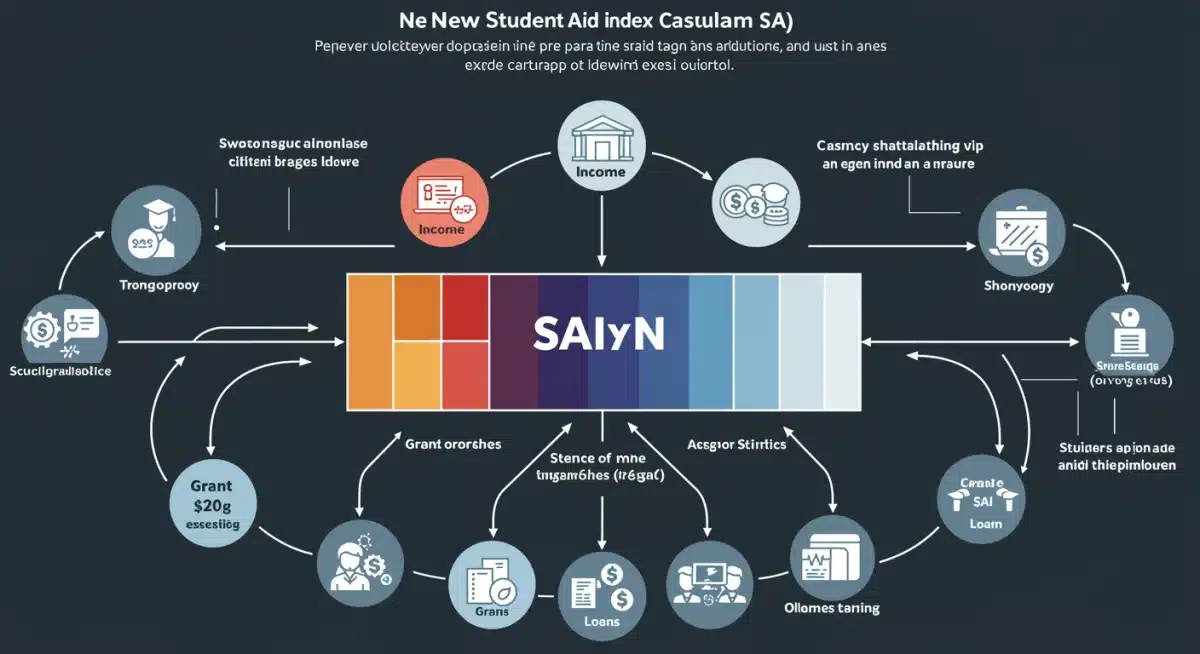
Moreover, the shift in how child support and small business/farm assets are treated reflects a broader effort to capture a more holistic view of a family’s financial capacity. These adjustments, while seemingly minor, can have a significant cumulative effect on the final SAI. It is imperative for applicants to understand these changes to ensure all financial information is reported correctly and to anticipate their potential aid package. The SAI is not just a number; it is the gateway to federal student aid, and its accurate calculation is paramount.
Streamlined Application Process and Data Exchange
Beyond the SAI, the 2025 FAFSA also promises a significantly streamlined application experience, largely thanks to enhanced data exchange capabilities with the Internal Revenue Service (IRS). This integration is designed to reduce the number of questions students and families need to answer manually, thereby minimizing errors and speeding up the application process.
The new FAFSA will feature fewer questions overall, making the form less intimidating and quicker to complete. For many applicants, particularly those whose financial situations are relatively straightforward, the process could be reduced to just a handful of steps. This simplification is expected to encourage more students to apply, especially those who previously found the FAFSA too complex or time-consuming.
Key Process Improvements
- Direct Data Exchange with IRS: Mandatory use of the IRS Direct Data Exchange (DDX) for all applicants and contributors (parents/spouses). This securely transfers federal tax information directly to the FAFSA.
- Fewer Questions: The total number of questions on the FAFSA will be significantly reduced, from over 100 to approximately 36.
- Contributor Model: Introduction of the ‘contributor’ concept, where anyone providing financial information (student, parent, spouse) must consent to share their data via DDX.
- Expanded Online Access: Enhanced online platform designed for better user experience and mobile compatibility.
The mandatory use of the IRS Direct Data Exchange (DDX) is a cornerstone of this streamlined process. Previously known as the IRS Data Retrieval Tool (DRT), the DDX automatically pulls federal tax information directly into the FAFSA. This not only saves applicants time but also significantly reduces the likelihood of errors, which can often delay aid processing. It also enhances security by minimizing the direct handling of sensitive tax documents.
However, it’s crucial to understand that all contributors, including parents and spouses, must provide consent for their federal tax information to be transferred via DDX. Without this consent, the student will not be eligible for federal student aid. This new requirement emphasizes the importance of clear communication and cooperation among all parties involved in the application. The goal is a faster, more accurate, and less stressful application process for everyone involved.
Expanded Pell Grant Eligibility and Calculations
The FAFSA Simplification Act brings exciting news for students seeking federal grants, particularly through significant changes to Pell Grant eligibility and calculation. The intent is to expand access to this vital form of aid, making higher education a reality for more low-income students across the United States.
Under the new rules, more students will qualify for the maximum Pell Grant award, and more students will become eligible for Pell Grants for the first time. This expansion is primarily driven by changes in the SAI calculation and the introduction of new eligibility criteria based on federal poverty levels. These adjustments are designed to align Pell Grant eligibility more closely with a family’s true financial need.
Key Pell Grant Enhancements
- Maximum Pell Grant: Eligibility for the maximum Pell Grant will now be automatically determined based on family size and federal poverty level guidelines, simplifying the process for many.
- Minimum Pell Grant: A minimum Pell Grant will be guaranteed for students whose SAI is above zero but still demonstrates significant financial need, based on similar poverty level criteria.
- Repeal of Lifetime Limit: While not directly part of the 2025 FAFSA application, the simplification act has streamlined how lifetime Pell Grant eligibility is tracked.
The direct link between family size, federal poverty levels, and Pell Grant eligibility is a major step forward. For instance, students whose family income is at or below 175% (or 225% for single-parent households) of the federal poverty level will automatically qualify for a maximum Pell Grant. This provides a clear and straightforward pathway to significant financial assistance, removing much of the ambiguity that previously existed.
Furthermore, the introduction of a guaranteed minimum Pell Grant ensures that even students with a slightly higher SAI, but still demonstrating substantial need, will receive some level of support. This broadens the safety net, ensuring that fewer students fall through the cracks. These changes collectively represent a robust commitment to making federal student aid more accessible and impactful, ultimately fostering greater educational equity across the nation. Applicants should review the updated poverty guidelines to estimate their potential Pell Grant eligibility.
Impact on Specific Student Populations
The 2025 FAFSA changes are designed to benefit a broad range of students, but certain populations will experience a particularly significant impact. Understanding these specific implications can help students and families anticipate how the new rules will affect their aid eligibility and application process.
One of the most notable beneficiaries of the FAFSA Simplification Act are students from low-income backgrounds. The expanded Pell Grant eligibility, tied to federal poverty levels, means that many more students will receive a maximum Pell Grant, directly improving their ability to afford college. This is a crucial step towards closing equity gaps in higher education.
Specific Groups Affected
- Students with Divorced/Separated Parents: The new FAFSA will require the parent who provides the most financial support to the student to be the ‘contributor,’ regardless of which parent the student lives with most. This is a shift from the previous rule that considered the parent the student lived with most.
- Undocumented Parents: Parents without a Social Security Number (SSN) can now apply for an FSA ID, allowing them to complete their portion of the FAFSA online.
- Homeless and Foster Youth: The definition of ‘independent student’ has been expanded for these populations, making it easier for them to qualify for aid without parental information.
- Incarcerated Students: Pell Grant eligibility has been restored for incarcerated students, opening up new educational opportunities.
The change for students with divorced or separated parents is a significant procedural update. Previously, the FAFSA focused on the parent the student lived with more than 50% of the time. Now, the emphasis is purely on which parent provides the most financial support, which may require careful documentation and communication within blended families. This change aims to better reflect the true financial resources available to the student.
Furthermore, the ability for undocumented parents to obtain an FSA ID is a monumental step towards inclusivity. This allows them to fully participate in the FAFSA process online, ensuring their children can access federal aid. Similarly, the expanded definitions for independent students, particularly for homeless and foster youth, remove barriers that previously prevented these vulnerable populations from securing the financial aid they desperately need. These targeted changes reflect a commitment to ensuring that federal aid reaches all eligible students, regardless of their family structure or personal circumstances.
Step-by-Step Guide to Applying for 2025 FAFSA
With all the changes, applying for the 2025 FAFSA might seem daunting, but a clear step-by-step approach can simplify the process significantly. Being prepared and understanding each stage will help you navigate the new system effectively and maximize your aid potential.
The first and most crucial step is to gather all necessary documentation well in advance. This includes federal tax information, records of untaxed income, and asset information. Since the FAFSA will rely heavily on the IRS Direct Data Exchange (DDX), having accurate tax records is paramount. Ensure that all contributors (student, parents, spouse) have their FSA IDs and consent to the DDX process.
Application Steps
- Create an FSA ID: All applicants and contributors (parents, spouses) must have an FSA ID to access and sign the FAFSA electronically. This is a mandatory first step.
- Gather Required Documents: Collect federal tax returns (from two years prior to the academic year you’re applying for), W-2 forms, and records of any untaxed income. Also, have records of cash, savings, checking accounts, investments, and business/farm assets.
- Complete the FAFSA Online: Access the official FAFSA website. The streamlined form will guide you through the process, with many questions pre-filled via DDX.
- Provide Contributor Information: Each contributor will need to provide their consent and information, which will be securely transferred from the IRS.
- Review and Submit: Carefully review all information before submitting. Errors can delay processing and impact aid eligibility.
Once you’ve submitted your FAFSA, you will receive a FAFSA Submission Summary, which replaces the Student Aid Report (SAR). This summary will provide your Student Aid Index (SAI) and an estimate of your Pell Grant eligibility. Review this document carefully for any discrepancies.
Finally, if your financial circumstances change after submitting the FAFSA, or if you believe your aid package doesn’t accurately reflect your need, don’t hesitate to contact the financial aid office at your chosen institution. They have the authority to exercise professional judgment and make adjustments based on individual situations. Proactive engagement with financial aid professionals can be key to unlocking additional support. Following these steps systematically will ensure a smoother application experience and help you secure the federal aid you deserve.
Tips for Maximizing Federal Student Aid Opportunities
Navigating the FAFSA changes effectively requires more than just understanding the new rules; it demands a strategic approach to maximize your federal student aid opportunities. By implementing a few key tips, students and families can significantly improve their chances of receiving the most financial assistance possible.
One of the most fundamental tips is to apply early. While the FAFSA deadline is typically later in the academic year, many colleges award their institutional aid on a first-come, first-served basis. Submitting your FAFSA as soon as it opens (usually in December for the 2025-2026 academic year, though this has shifted from October) ensures you are considered for all available funds, including state and institutional grants that may have limited budgets.
Strategic Aid Maximization Tips
- Apply Early: Submit your FAFSA as soon as possible after it opens to be considered for all available aid.
- Accurate Reporting: Double-check all financial information for accuracy. Errors, even minor ones, can lead to delays or incorrect aid calculations.
- Understand the SAI: Familiarize yourself with how the new Student Aid Index (SAI) is calculated and how your family’s specific financial situation impacts it.
- Communicate Changes: If your financial situation changes significantly after submitting the FAFSA (e.g., job loss, medical expenses), notify your college’s financial aid office.
- Seek Professional Judgment: Don’t hesitate to request a review from your college’s financial aid office if you believe your FAFSA doesn’t accurately reflect your family’s ability to pay.
Another critical piece of advice is to be meticulous with your financial reporting. While the IRS Direct Data Exchange (DDX) automates much of the income transfer, you are still responsible for ensuring that all other assets and untaxed income are reported correctly. Inaccurate information can lead to a lower aid package or, worse, requiring repayment of aid if errors are discovered later.
Furthermore, understanding the nuances of the SAI calculation, especially regarding assets, can be beneficial. For instance, retirement accounts are generally not included in the SAI calculation, making them a wise place to save for college without negatively impacting aid eligibility. Conversely, funds held in a student’s name may have a greater impact on aid than those held in a parent’s name. Strategic financial planning well before applying for FAFSA can make a substantial difference. By staying informed and proactive, you can effectively navigate the 2025 FAFSA changes and unlock the maximum federal student aid available to you.
| Key Change | Brief Description |
|---|---|
| EFC to SAI | Expected Family Contribution (EFC) replaced by Student Aid Index (SAI), which can be negative, indicating higher need. |
| Streamlined Application | Fewer questions and mandatory IRS Direct Data Exchange (DDX) for all contributors. |
| Pell Grant Expansion | Increased eligibility for maximum and minimum Pell Grants based on federal poverty levels. |
| Contributor Model | All individuals providing financial data (student, parent, spouse) must consent to DDX. |
Frequently Asked Questions About 2025 FAFSA
The most significant change is the replacement of the Expected Family Contribution (EFC) with the Student Aid Index (SAI). The SAI uses a different calculation methodology, can be a negative number, and aims to more accurately reflect a family’s financial need for federal student aid eligibility.
The DDX will automatically and securely transfer federal tax information directly from the IRS to your FAFSA form. All applicants and contributors (parents, spouses) must provide consent for this data exchange to complete the application and determine aid eligibility.
Yes, the 2025 FAFSA changes are designed to expand Pell Grant eligibility. More students will qualify for maximum Pell Grants based on family size and federal poverty levels, and a minimum Pell Grant will be guaranteed for those with significant need.
A ‘contributor’ is anyone required to provide information on the FAFSA, including the student, their parents (if dependent), and their spouse (if married). All contributors must provide consent for the IRS DDX to process the application.
While the exact opening date varies, it is generally recommended to apply as soon as the FAFSA becomes available, typically in December for the 2025-2026 academic year. Early submission ensures consideration for all available federal, state, and institutional aid.
Conclusion
The 2025 FAFSA changes represent a transformative moment in federal student aid, promising a simpler, more equitable, and more accessible path to higher education for countless students. By replacing the EFC with the SAI, streamlining the application process through IRS data exchange, and expanding Pell Grant eligibility, these reforms aim to empower students and families to navigate college financing with greater confidence. Understanding these updates, preparing thoroughly, and engaging proactively with financial aid resources are essential steps to maximizing federal student aid opportunities. As you embark on your educational journey, remember that knowledge and preparation are your strongest allies in securing the financial support you need to achieve your academic aspirations.
Author