Understanding Stablecoins: An Educational Guide to Their Mechanics and Use Cases in 2026

Understanding Stablecoins: An Educational Guide to Their Mechanics and Use Cases in 2026
In the rapidly evolving landscape of digital finance, stablecoins have emerged as a cornerstone, bridging the volatile world of cryptocurrencies with the stability of traditional fiat currencies. As we navigate through 2026, their importance has only magnified, becoming indispensable tools for a myriad of financial activities. This comprehensive guide aims to demystify stablecoins, delving into their fundamental mechanics, exploring the diverse types that exist, and highlighting their ever-expanding use cases in the contemporary digital economy.
The journey into stablecoins is not merely an academic exercise; it’s an exploration of a technology that is reshaping global finance. From facilitating seamless international remittances to powering the complex ecosystems of Decentralized Finance (DeFi), stablecoins offer a unique blend of blockchain’s efficiency and conventional currency’s reliability. Understanding Stablecoin Mechanics Guide is crucial for anyone looking to engage with, invest in, or simply comprehend the future of money.
The Genesis of Stablecoins: Addressing Crypto Volatility
Before stablecoins, the primary deterrent for widespread cryptocurrency adoption was their inherent price volatility. While this volatility could lead to significant gains, it also presented substantial risks, making cryptocurrencies impractical for everyday transactions, payroll, or as a reliable store of value. Imagine trying to pay for groceries with a currency whose value could swing by 10% in an hour; it’s simply unsustainable for a functional economy.
This challenge paved the way for the invention of stablecoins. The core idea was elegant: create a digital asset on a blockchain that maintains a stable value, typically pegged to a fiat currency like the US Dollar, but also to commodities like gold, or even other cryptocurrencies. This stability is what gives them their name – ‘stable’ coins. By mitigating price fluctuations, stablecoins unlocked a vast array of possibilities for blockchain technology, allowing it to move beyond speculative trading into practical financial applications.
The initial stablecoins focused on simple fiat backing, but the concept has evolved dramatically, leading to more complex and innovative mechanisms. This evolution reflects the industry’s continuous effort to find the most secure, transparent, and scalable ways to achieve price stability in a decentralized environment. Our Stablecoin Mechanics Guide will unpack these developments, providing clarity on how these digital assets achieve their remarkable steadiness.
Decoding Stablecoin Mechanics: How Stability is Achieved
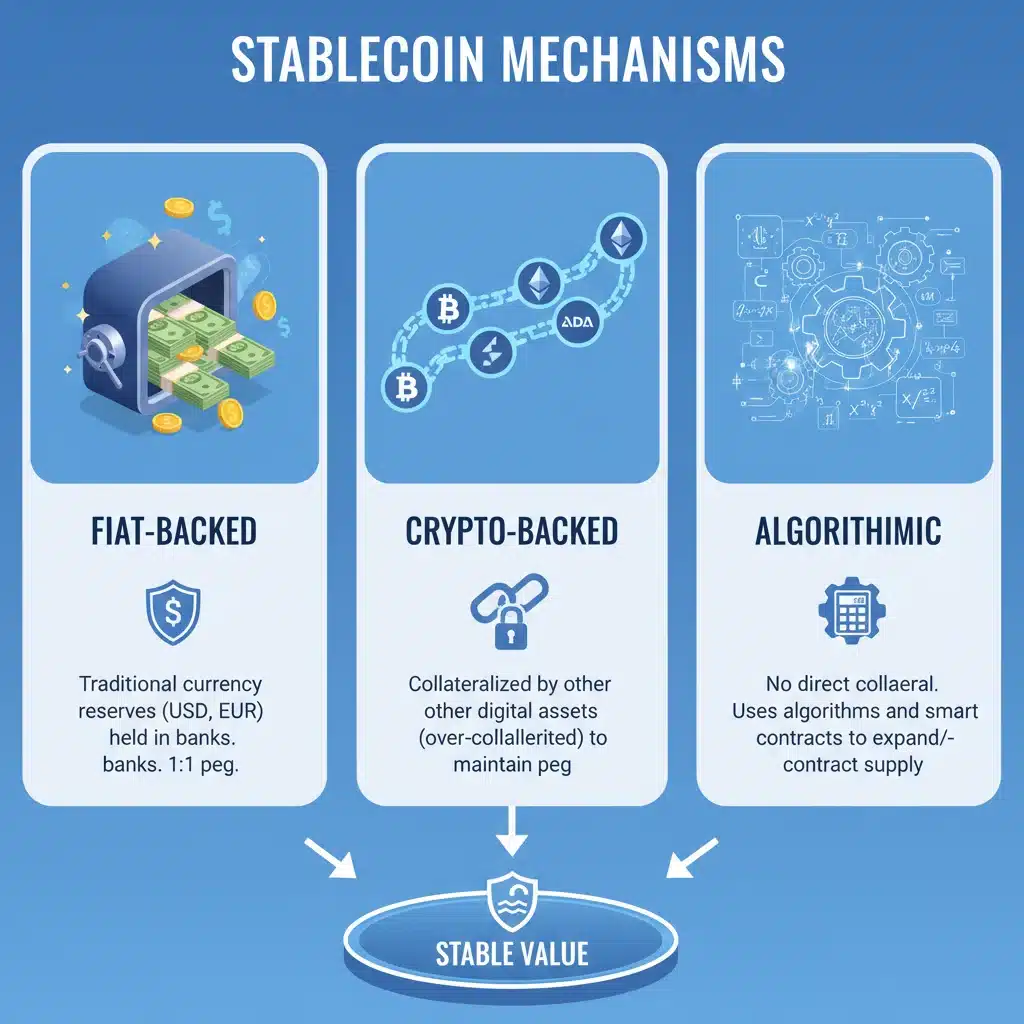
The fundamental promise of a stablecoin is its price peg. But how do these digital assets, built on volatile blockchain networks, manage to maintain a consistent value? The answer lies in their diverse underlying mechanisms. There isn’t a single way to build a stablecoin; rather, different approaches offer varying degrees of decentralization, transparency, and risk. Understanding these mechanisms is key to appreciating the resilience and potential vulnerabilities of various stablecoins.
Fiat-Backed Stablecoins: The Centralized Anchor
The most common and arguably the simplest form of stablecoin is fiat-backed. These stablecoins maintain their peg by holding an equivalent reserve of fiat currency (like USD, EUR, or GBP) in a traditional bank account for every stablecoin issued. Examples include Tether (USDT), USD Coin (USDC), and Binance USD (BUSD).
- Mechanism: For every 1 stablecoin issued, 1 unit of fiat currency is held in reserve. When a user wants to redeem their stablecoins, the issuer burns the stablecoins and returns the corresponding fiat currency.
- Stability: The stability is directly tied to the issuer’s ability to maintain sufficient reserves and honor redemptions. Regular audits are crucial to verify these reserves.
- Pros: Generally seen as the most straightforward and easiest to understand. High liquidity and widely accepted.
- Cons: Centralized nature introduces counterparty risk. The transparency of reserves has been a point of contention for some issuers. Regulatory scrutiny is increasing.
The trust model here is similar to traditional banking: you trust the issuer to hold your funds. However, the blockchain provides a transparent ledger of the stablecoins in circulation, allowing for easier verification of the supply side.
Crypto-Backed Stablecoins: Decentralization with Overcollateralization
Crypto-backed stablecoins, often referred to as overcollateralized stablecoins, achieve stability by being backed by other cryptocurrencies rather than fiat. To account for the inherent volatility of the backing assets, these stablecoins are typically overcollateralized. This means that a user must deposit more value in cryptocurrency than the stablecoin they wish to mint.
- Mechanism: Users lock up a certain amount of volatile cryptocurrency (e.g., Ethereum) into a smart contract to mint a smaller value of the stablecoin. If the value of the collateral falls below a certain threshold, the collateral can be liquidated to maintain the stablecoin’s peg.
- Stability: Maintained through overcollateralization and liquidation mechanisms. The system is designed to absorb price swings in the underlying collateral.
- Pros: More decentralized than fiat-backed stablecoins, reducing reliance on a central entity. Transparency is high as collateral can often be viewed on-chain.
- Cons: Capital inefficiency due to overcollateralization. Risk of liquidation if the collateral’s price drops sharply. Can be more complex for new users.
Dai (DAI) from MakerDAO is the most prominent example of a crypto-backed stablecoin. Its resilience during periods of extreme market volatility has showcased the robustness of this model, making it a key component of the DeFi ecosystem. Understanding the nuances of this Stablecoin Mechanics Guide is vital for DeFi participants.
Algorithmic Stablecoins: The Code-Driven Approach
Algorithmic stablecoins represent the most innovative and, at times, the most experimental approach to achieving price stability. Unlike fiat-backed or crypto-backed stablecoins, they do not rely on direct asset reserves. Instead, their stability is maintained through a set of algorithms and smart contracts that automatically adjust the supply of the stablecoin in response to demand and price fluctuations.
- Mechanism: When the stablecoin’s price rises above its peg (e.g., $1), the algorithm increases the supply of the stablecoin to bring the price down. Conversely, if the price falls below the peg, the algorithm reduces the supply (e.g., through burning mechanisms or incentives for users to ‘lock up’ stablecoins) to drive the price back up.
- Stability: Dependent on the effectiveness and robustness of the underlying algorithms, market participants’ trust, and sufficient incentives to maintain the peg.
- Pros: Highly decentralized and capital-efficient as they don’t require large reserves. Potential for greater scalability.
- Cons: Highly complex and prone to ‘death spirals’ if market confidence is lost or the algorithms fail under extreme stress. Many algorithmic stablecoins have failed in the past.
The collapse of TerraUSD (UST) in 2022 serves as a stark reminder of the risks associated with poorly designed or executed algorithmic stablecoins. While the allure of a truly decentralized, capital-efficient stablecoin remains strong, the path to achieving it is fraught with challenges. Future innovations in this area will undoubtedly be a significant part of our ongoing Stablecoin Mechanics Guide discussions.
The Hybrid Models and Future of Stablecoin Mechanics
Beyond these three primary categories, the stablecoin landscape is continually innovating, leading to hybrid models that combine elements from different approaches. For instance, some stablecoins might use a basket of fiat currencies and commodities, while others might blend crypto-backing with algorithmic elements to enhance stability and decentralization. The goal is always to find the optimal balance between stability, decentralization, capital efficiency, and scalability.
As we look to 2026 and beyond, research and development in stablecoin mechanics are focusing on several key areas:
- Improved Risk Management: Developing more sophisticated liquidation mechanisms and stress testing for crypto-backed and algorithmic models.
- Regulatory Compliance: Adapting to evolving global regulations, particularly for fiat-backed stablecoins, to ensure transparency and consumer protection.
- Cross-Chain Functionality: Enabling stablecoins to move seamlessly across different blockchain networks, enhancing their utility in a multi-chain world.
- Privacy-Preserving Stablecoins: Exploring ways to incorporate privacy features while maintaining regulatory compliance and transparency where needed.
The evolution of Stablecoin Mechanics Guide will be a continuous process, driven by technological advancements, market demands, and regulatory frameworks. The lessons learned from past failures are instrumental in building more robust and resilient stablecoin ecosystems for the future.
The Broadening Use Cases of Stablecoins in 2026
The stability offered by stablecoins has unlocked a myriad of practical applications, transforming them from mere speculative assets into foundational elements of the digital economy. In 2026, their utility spans across various sectors, demonstrating their versatility and indispensable nature.
Facilitating Global Remittances and International Payments
One of the most impactful use cases for stablecoins is in cross-border transactions. Traditional international payments are often slow, expensive, and opaque, involving multiple intermediaries. Stablecoins, being blockchain-based, enable near-instantaneous, low-cost, and transparent transfers of value across borders, 24/7.
- Reduced Fees: Significantly lower transaction costs compared to traditional wire transfers or money remittance services.
- Faster Settlements: Transactions can settle in minutes, rather than days, improving cash flow for businesses and individuals.
- Financial Inclusion: Providing access to quick and affordable financial services for the unbanked and underbanked populations globally.
This application alone positions stablecoins as a major disruptor to traditional financial institutions, offering a more efficient and equitable system for global money movement. It’s a prime example of how understanding the Stablecoin Mechanics Guide translates into real-world benefits for millions.
Powering the Decentralized Finance (DeFi) Ecosystem
Stablecoins are the lifeblood of Decentralized Finance (DeFi). Without them, the DeFi ecosystem, which includes lending, borrowing, decentralized exchanges (DEXs), and yield farming, would struggle with the volatility inherent in other cryptocurrencies.
- Lending and Borrowing: Users can lend stablecoins to earn interest or borrow stablecoins against their crypto collateral without fear of drastic principal value changes.
- Trading Pairs: Stablecoins serve as a reliable base currency on DEXs, allowing traders to move in and out of volatile assets without converting back to fiat.
- Yield Farming: A significant portion of yield farming strategies involves stablecoin liquidity pools, offering relatively stable returns compared to volatile asset pools.
- Payment for Services: Many DeFi protocols and blockchain-based services accept stablecoins for fees or subscriptions, ensuring predictable costs.
The stability provided by these digital assets allows for the creation of sophisticated financial instruments and services that mirror, and in some cases, surpass those found in traditional finance, all within a transparent and permissionless environment. This deep integration is a critical aspect of our Stablecoin Mechanics Guide.
Enhancing E-commerce and Retail Payments
The advantages of stablecoins – speed, low fees, and global reach – make them an attractive option for e-commerce and retail payments. Merchants can accept stablecoins without worrying about price fluctuations between the time of sale and settlement, and consumers can make purchases without incurring high transaction fees.
- Price Stability for Merchants: Businesses can price goods and services in stablecoins, knowing their value won’t drastically change.
- Reduced Transaction Costs: Lower fees for both merchants and consumers compared to credit card processing fees.
- Faster Settlements: Merchants receive funds quicker, improving cash flow.
- Global Reach: Facilitates sales to a worldwide customer base without complex currency conversions.
As blockchain technology becomes more integrated into mainstream commerce, stablecoins are poised to play a significant role in redefining how we pay for goods and services online and in physical stores.
Payroll and Salary Payments
For individuals and businesses operating in the crypto space, or those looking for more efficient payment methods, stablecoins offer an excellent solution for payroll and salary distribution. Employees can receive their wages in a digital asset that maintains its value, avoiding the volatility of other cryptocurrencies while still benefiting from blockchain’s efficiencies.
- Predictable Value: Employees receive a consistent value, similar to fiat currency.
- Immediate Access: Funds are available almost instantly, especially beneficial for international teams.
- Reduced Administrative Overhead: Streamlined payment processes through smart contracts can automate payroll.
This use case highlights stablecoins’ potential to modernize traditional financial processes, making them more efficient and globally accessible. The practical application of Stablecoin Mechanics Guide extends even to fundamental aspects of employment.
Store of Value and Savings Alternative
While not a primary store of value like gold, stablecoins can serve as a temporary store of value for crypto investors looking to exit volatile positions without converting back to fiat, or for individuals in hyperinflationary economies seeking refuge from rapidly depreciating local currencies.
- Hedge Against Volatility: A safe haven during crypto market downturns.
- Alternative to Fiat in Volatile Economies: Providing a more stable digital alternative for savings when local currencies are unstable.
- Earning Interest: Many platforms allow users to earn interest on stablecoin holdings, offering a yield that often surpasses traditional savings accounts.
This function underscores their role in providing a sense of financial security and flexibility within the broader digital asset ecosystem.

Risks and Challenges in the Stablecoin Landscape 2026
Despite their numerous advantages and expanding use cases, stablecoins are not without their risks and challenges. As the industry matures, addressing these issues becomes paramount for sustained growth and wider adoption.
Regulatory Scrutiny and Compliance
The most significant challenge facing stablecoins, particularly fiat-backed ones, is regulatory uncertainty. Governments and financial regulators worldwide are increasingly scrutinizing stablecoins due to concerns about financial stability, consumer protection, money laundering, and illicit financing. The collapse of UST further intensified these calls for regulation.
- Clarity Needed: Lack of clear regulatory frameworks can hinder innovation and adoption.
- Consumer Protection: Ensuring stablecoin issuers maintain adequate reserves and operate transparently.
- Systemic Risk: Concerns that a large, widely adopted stablecoin could pose a systemic risk to the traditional financial system if it were to fail.
In 2026, we anticipate more concrete regulatory frameworks emerging globally, which will undoubtedly shape the future development and deployment of stablecoins. This regulatory evolution is a crucial part of the Stablecoin Mechanics Guide narrative.
Reserve Transparency and Auditing
For fiat-backed stablecoins, the transparency and verifiability of their reserves remain a critical point of concern. While many issuers claim to hold 1:1 reserves, independent and regular audits are essential to build and maintain public trust. Past controversies surrounding reserve disclosures have highlighted the need for greater transparency and accountability.
- Independent Audits: The necessity of frequent, comprehensive audits by reputable third parties.
- Real-time Proof of Reserves: Exploring technological solutions for on-chain, real-time verification of reserves.
Improved standards for reserve transparency will be vital for the long-term credibility and widespread acceptance of these digital assets.
Algorithmic Stablecoin Fragility
As previously discussed, algorithmic stablecoins, while offering the promise of decentralization and capital efficiency, have demonstrated significant fragility. The complex economic models and reliance on market incentives can break down under extreme market conditions, leading to rapid de-pegging and significant losses.
- Design Complexity: The intricate nature of their algorithms makes them susceptible to unforeseen vulnerabilities.
- Market Confidence: Highly reliant on sustained market confidence; a loss of trust can quickly lead to a death spiral.
Future iterations of algorithmic stablecoins will need to incorporate more robust mechanisms and perhaps hybrid approaches to mitigate these inherent risks, learning from the lessons of 2022.
Centralization Risks
Even with crypto-backed stablecoins, certain elements can introduce centralization risks. For instance, the governance of the underlying protocol (like MakerDAO for Dai) or the oracles that feed price data can represent single points of failure or control. For fiat-backed stablecoins, the centralized issuer is an obvious point of centralization risk.
- Governance Concentration: The potential for a small group of stakeholders to influence critical decisions.
- Oracle Dependence: Reliance on external data feeds for collateral prices, which could be manipulated or fail.
The pursuit of true decentralization remains an ongoing challenge across the entire blockchain ecosystem, including stablecoins. This is a fundamental consideration within any comprehensive Stablecoin Mechanics Guide.
The Future Outlook for Stablecoins in 2026
Looking ahead to 2026, stablecoins are poised for continued growth and deeper integration into both the crypto and traditional financial systems. Several trends indicate their expanding influence:
- Increased Institutional Adoption: More financial institutions, corporations, and even central banks (via Central Bank Digital Currencies or CBDCs, which share some characteristics with stablecoins) will explore and adopt stablecoins for various applications.
- Regulatory Clarity: As regulatory frameworks become clearer, it will provide a more stable environment for innovation and investment, attracting more mainstream participation.
- Technological Advancements: Continuous improvements in blockchain technology, smart contract security, and stablecoin design will lead to more robust, efficient, and user-friendly stablecoins.
- Cross-Chain Interoperability: The ability for stablecoins to seamlessly move between different blockchains will unlock new levels of utility and liquidity across the entire digital asset landscape.
- Diversification of Pegs: While USD-pegged stablecoins currently dominate, we might see a greater diversification into other fiat currencies, baskets of currencies, or even specialized commodity-pegged stablecoins tailored for specific industries.
The trajectory points towards stablecoins becoming an even more integral part of global finance, facilitating a more interconnected, efficient, and accessible financial system. Their role as a bridge between traditional finance and the decentralized future cannot be overstated. This Stablecoin Mechanics Guide serves as a foundational text for understanding this pivotal transformation.
Conclusion: Stablecoins as a Pillar of the Digital Economy
Stablecoins have undoubtedly transformed the cryptocurrency landscape, offering a vital solution to the challenge of volatility. By providing a stable medium of exchange and a reliable store of value within the blockchain ecosystem, they have unlocked a vast array of practical applications, from global payments and DeFi to e-commerce and payroll.
As we’ve explored in this Stablecoin Mechanics Guide, the methods by which stablecoins achieve their stability are diverse, each with its own set of advantages and disadvantages. From the centralized, fiat-backed models to the decentralized, overcollateralized crypto-backed systems, and the ambitious algorithmic designs, innovation continues to drive the evolution of this critical digital asset class.
While challenges such as regulatory uncertainty, reserve transparency, and the inherent risks of certain models persist, the industry is actively working to address these issues. The lessons learned from past experiences are paving the way for more robust, secure, and resilient stablecoin architectures.
In 2026, stablecoins are not just a niche product for crypto enthusiasts; they are a fundamental pillar of the digital economy, enabling greater efficiency, financial inclusion, and innovation across global financial markets. Understanding their mechanics and use cases is no longer optional but essential for anyone navigating the future of finance. Their journey is far from over, and their importance is only set to grow.
Author