Boost Your 401(k) Match by 5% in 2026: A Comprehensive Guide

Are you looking to significantly boost your retirement savings? Imagine increasing your employer’s 401(k) match by a full 5% by 2026. While it might sound ambitious, with strategic planning and a deep understanding of your 401(k) plan, this goal is entirely achievable. This comprehensive guide will walk you through the steps, considerations, and advanced strategies to help you optimize 401k match and secure a more prosperous financial future. The journey to a robust retirement portfolio begins now, and understanding how to maximize every dollar your employer contributes is a critical first step.
Many employees leave significant amounts of free money on the table simply because they don’t fully understand their 401(k) benefits or how to leverage them. Your employer’s match is essentially a guaranteed return on your investment – often far surpassing what you could achieve through other low-risk avenues. By focusing on increasing this match, you’re not just saving more; you’re accelerating your wealth accumulation with minimal additional effort on your part. Let’s delve into the specifics of how you can make this happen.
Understanding Your Current 401(k) Plan and Employer Match
Before you can aim to increase your 401(k) match, you need a crystal-clear understanding of your current plan’s structure. This involves more than just knowing that your employer offers a match; it means diving into the specifics. What is your employer’s current matching formula? Is it a dollar-for-dollar match up to a certain percentage of your salary, or is it a 50-cent-on-the-dollar match? Knowing these details is fundamental to crafting an effective strategy to optimize 401k match.
For example, some common matching formulas include: ‘50% of your contributions up to 6% of your salary’ or ‘100% of your contributions up to 3% of your salary, then 50% on the next 2%.’ Each formula has different implications for how much you need to contribute to maximize the free money. Don’t assume you know; verify it by checking your plan documents, contacting your HR department, or logging into your 401(k) provider’s portal.
Key Components to Scrutinize:
- Matching Formula: As mentioned, this is the core. Understand the percentage and the ceiling.
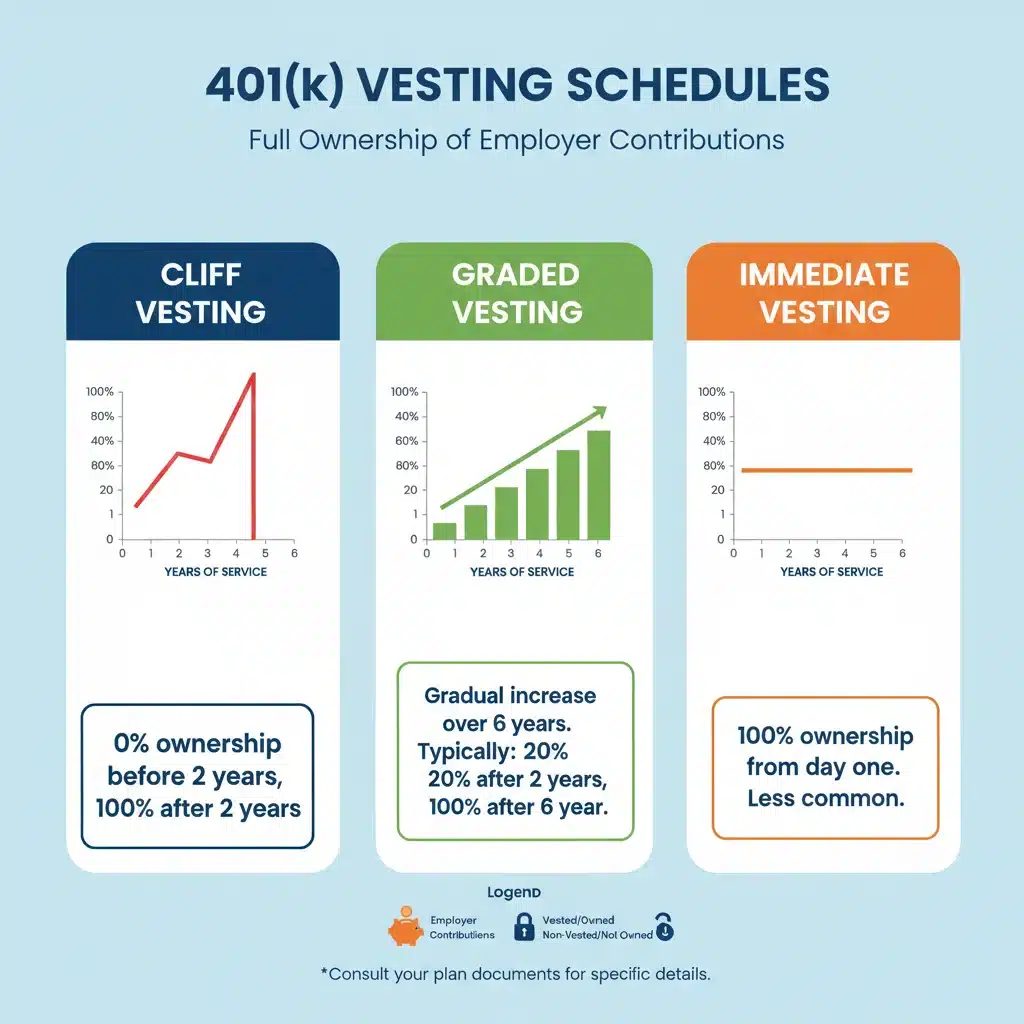
- Vesting Schedule: This is crucial. Vesting refers to the ownership you have over your employer’s contributions. Some plans have immediate vesting, meaning the money is yours right away. Others have a ‘cliff’ vesting (e.g., 100% after 3 years) or a ‘graded’ vesting (e.g., 20% after 1 year, 40% after 2, etc.). If you leave before being fully vested, you could lose some or all of the employer’s contributions. Knowing your vesting schedule helps you plan your career moves and understand the true value of the match.
- Contribution Limits: Be aware of the IRS annual contribution limits for 401(k)s, which often increase each year. For 2026, these limits will likely be higher than current limits. While your employer match is separate from your personal contribution limit, understanding both helps you strategize your overall savings.
- Eligibility Requirements: When did you become eligible to participate in the 401(k) plan and receive the match? Are there any minimum hours worked or tenure requirements?
Gathering this information is the bedrock of your plan to optimize 401k match. Without it, you’re essentially flying blind. Take the time to read through your plan’s Summary Plan Description (SPD), which is a legally required document that outlines all the important aspects of your 401(k).
Maximizing Your Personal Contributions to Trigger a Higher Match
The most direct way to increase your employer’s 401(k) match is often by increasing your own contributions. Most employer matching schemes are designed as an incentive for you to save, meaning the more you put in (up to a certain point), the more they contribute. If your employer matches 100% of your contributions up to 3% of your salary, and you’re only contributing 2%, you’re missing out on 1% of free money. To optimize 401k match, you must at least contribute enough to get the full employer match.
Strategies for Increasing Your Contributions:
- Hit the Match Threshold: This is non-negotiable. If you’re not contributing enough to get the maximum possible match, make this your immediate goal. Even if it means making small adjustments to your budget, the long-term benefits of this ‘free money’ are immense.
- Automate Increases: Many 401(k) plans allow you to set up automatic contribution increases. For example, you can elect to increase your contribution rate by 1% each year. This ‘set it and forget it’ approach can painlessly lead to significant increases over time, helping you optimize 401k match without feeling a major pinch in your paycheck.
- Leverage Raises and Bonuses: When you receive a raise or a bonus, consider allocating a portion of that extra income directly to your 401(k). Since it’s new money, you won’t feel the loss, and you’ll accelerate your savings. This is an excellent way to boost your contribution rate without impacting your current lifestyle.
- Understand the ‘Catch-Up’ Provision: If you’re age 50 or older, the IRS allows you to make additional ‘catch-up’ contributions to your 401(k) above the standard annual limit. While these contributions don’t typically trigger additional employer match beyond the regular limits, contributing more can free up your regular contributions to ensure you hit the maximum match threshold.
Remember, the goal isn’t just to contribute; it’s to contribute strategically to unlock every possible dollar from your employer. Each percentage point you increase your contribution, especially if it’s matched, compounds significantly over your working life.
Negotiating for a Better Match: Is It Possible?
This is where things get a bit more nuanced. Directly negotiating for a higher 401(k) match as an individual employee is often challenging, especially in larger organizations. However, it’s not entirely out of the question, and there are indirect ways to influence it. For smaller companies or startups, there might be more flexibility.
Approaches to Consider:
- As Part of Compensation Negotiation: If you’re joining a new company or are due for a significant promotion, you might be able to negotiate your overall compensation package, which could include benefits like a 401(k) match. While employers are unlikely to change the company-wide match for one individual, you might be able to negotiate other forms of compensation that effectively offset a lower match, or if the match is discretionary, argue for a higher percentage based on your value to the company.
- Collective Employee Feedback: In some cases, if a significant number of employees express interest in an improved 401(k) match, HR or management might consider reviewing the benefits package. This is more common in companies with strong employee advocacy groups or where management is highly responsive to employee feedback.
- Understanding Industry Benchmarks: Research what competitors in your industry offer in terms of 401(k) matches. If your company’s match is significantly below the industry average, presenting this data to HR or management (respectfully and constructively) could be a catalyst for change. Employers want to attract and retain top talent, and competitive benefits are a key part of that.
- Directly Asking (with caution): For smaller businesses, a direct conversation with your employer might be appropriate. Frame it as a discussion about long-term financial security and employee retention. Be prepared to explain the value of a strong 401(k) plan for both you and the company.
While direct negotiation for a 5% increase in your match for 2026 might be a long shot as an individual, understanding the avenues for discussion and being prepared can open doors. The goal here is to explore all possibilities to optimize 401k match, even the less conventional ones.
Evaluating and Changing Investment Options Within Your 401(k)
While not directly about increasing the employer match, optimizing your investment choices within your 401(k) can significantly impact the overall growth of your retirement savings, making the employer match even more valuable. A higher growth rate means your matched contributions, along with your own, will compound more effectively over time. To optimize 401k match, you also need to optimize the growth of those matched funds.
Key Investment Considerations:
- Risk Tolerance and Time Horizon: Your investment strategy should align with how comfortable you are with risk and how many years you have until retirement. Younger investors with a longer time horizon can generally afford to take on more risk (e.g., higher allocation to stocks) for potentially higher returns. As you get closer to retirement, you might shift towards more conservative investments.
- Diversification: Don’t put all your eggs in one basket. Diversify your investments across different asset classes (stocks, bonds, real estate, etc.) and within those classes (e.g., large-cap, mid-cap, small-cap stocks; domestic and international stocks). Most 401(k)s offer a selection of mutual funds or ETFs that provide diversification.
- Expense Ratios: Pay close attention to the expense ratios of the funds you choose. These are annual fees charged as a percentage of your investment. Even seemingly small differences in expense ratios can eat into your returns significantly over decades. Opt for low-cost index funds or ETFs when available.
- Target-Date Funds: If you prefer a hands-off approach, target-date funds can be an excellent option. These funds automatically adjust their asset allocation over time, becoming more conservative as you approach the target retirement date.
- Regular Review: Your investment strategy shouldn’t be static. Review your portfolio at least once a year, or whenever there are significant life changes (e.g., marriage, new child, job change). Rebalance your portfolio as needed to maintain your desired asset allocation.
A well-managed investment portfolio magnifies the impact of your employer’s match. Even a small improvement in your annual return can translate into tens or hundreds of thousands of dollars more in retirement savings, making your efforts to optimize 401k match even more rewarding.
Understanding Vesting Schedules and Their Impact
As briefly touched upon, the vesting schedule of your 401(k) plan is paramount when considering the true value of your employer’s match. It dictates when the matched contributions become 100% yours. If you leave your job before you are fully vested, you could forfeit a significant portion of the ‘free money’ your employer contributed. This directly impacts your ability to optimize 401k match over the long term.
Types of Vesting Schedules:
- Immediate Vesting: The best-case scenario. All employer contributions are yours from day one. If you have this, congratulations!
- Cliff Vesting: You own 0% of the employer contributions until you meet a specific service requirement (e.g., 3 years). Once you hit that ‘cliff,’ you become 100% vested. If you leave a day before the cliff, you get nothing.
- Graded Vesting: You become partially vested over time, with the percentage increasing each year until you reach 100%. A common schedule might be 20% after 2 years, 40% after 3, 60% after 4, 80% after 5, and 100% after 6 years.
Why is this important for increasing your match by 5% by 2026? If you’re considering a job change, understanding your vesting schedule is critical. Leaving a job just before a significant vesting milestone means leaving money on the table. Conversely, if you’re approaching full vesting, it might be a factor in your decision-making process, encouraging you to stay longer to fully capture those matched funds. To truly optimize 401k match, you need to ensure those funds are actually yours.
Always factor your vesting schedule into your career planning. The goal isn’t just to get the match, but to keep it. If you’re not fully vested, those matched contributions are merely potential money, not actual money in your pocket for retirement.
Leveraging Financial Advisors and Resources
Navigating the complexities of 401(k) plans, investment options, and financial planning can be daunting. This is where professional help can be invaluable. A qualified financial advisor can provide personalized guidance, helping you understand your plan better and strategize to optimize 401k match.
How a Financial Advisor Can Help:
- Plan Analysis: They can help you decipher your 401(k) plan documents, explain the matching formula, vesting schedule, and investment options in clear terms.
- Contribution Strategy: An advisor can help you determine the optimal contribution rate to maximize your employer match while balancing other financial goals.
- Investment Selection: They can guide you in choosing appropriate investment funds within your 401(k) that align with your risk tolerance and retirement timeline, potentially leading to higher returns.
- Overall Financial Planning: Your 401(k) is just one piece of your financial puzzle. An advisor can help integrate your 401(k) strategy into a broader financial plan that includes other savings, debt management, and future goals.
- Stay Updated: Financial regulations and market conditions change. An advisor can help you stay informed and adjust your strategy accordingly to continue to optimize 401k match and overall retirement savings.
Many 401(k) providers offer access to financial education and sometimes even one-on-one consultations as part of their services. Take advantage of these resources. Additionally, online tools and calculators can help you project your retirement savings based on different contribution and growth rates, giving you a clear picture of the impact of increasing your match.

Communicating with HR and Your 401(k) Provider
Don’t underestimate the power of direct communication. Your HR department and your 401(k) plan provider are excellent resources for understanding and optimizing your benefits. They are there to help you, and asking informed questions can lead to valuable insights.
Questions to Ask:
- ‘Can you confirm my employer’s exact 401(k) matching formula and the maximum percentage of my salary they will match?’
- ‘What is my current vesting status, and what is the full vesting schedule for employer contributions?’
- ‘Are there any plans to review or change the 401(k) matching contribution in the near future, specifically looking towards 2026?’ (This is a subtle way to gauge potential future increases.)
- ‘Can you provide me with the Summary Plan Description (SPD) for my 401(k) plan?’
- ‘Are there any educational resources or workshops available to help employees understand their 401(k) benefits better?’
By engaging with these resources, you not only gain clarity but also demonstrate your proactive interest in your retirement savings. This can sometimes lead to being informed about changes or opportunities that might not be widely publicized. To truly optimize 401k match, you need to be an active participant in understanding your plan.
Projecting Your Savings Growth to 2026 and Beyond
Visualizing the impact of a 5% increase in your employer match can be incredibly motivating. Let’s consider a hypothetical scenario to illustrate the power of this increase. Suppose you earn $70,000 annually, and your employer currently matches 3% of your salary. If you manage to increase that match by 5% (meaning a total of 8% employer match), the numbers become compelling.
Hypothetical Calculation:
- Current Match: 3% of $70,000 = $2,100 per year.
- Target Match (by 2026): 8% of $70,000 = $5,600 per year.
- Annual Increase in Employer Contribution: $5,600 – $2,100 = $3,500.
This additional $3,500 per year, compounded over decades, can lead to hundreds of thousands of dollars more in retirement. Even if the increase is a 5% *additional* match on top of what you already receive (e.g., from 3% to 8%), or if it’s a 5% *point increase* in your contribution that triggers a higher match, the impact is substantial. For example, if your employer matches 50 cents on the dollar up to 10% of your salary, and you increase your contribution from 5% to 10%, you’ve effectively increased your employer’s contribution by 2.5% of your salary (50% of the additional 5%).
Use online retirement calculators to plug in different scenarios. See how an extra $3,500, or whatever your projected increase might be, impacts your projected retirement nest egg by 2026 and then by your retirement age. This exercise can reinforce the value of your efforts to optimize 401k match.
Long-Term Benefits of an Optimized 401(k) Match
The immediate goal is to optimize 401k match by 5% by 2026, but the true benefits extend far beyond that year. A higher employer match provides a significant head start and continuous boost to your retirement savings, leading to a more secure and comfortable future.
Key Long-Term Advantages:
- Accelerated Compounding: More money invested earlier means more time for compound interest to work its magic. Even small increases in contributions or match can lead to exponential growth over decades.
- Reduced Personal Burden: The more your employer contributes, the less pressure there is on you to save an equivalent amount from your own paycheck to reach your retirement goals. This can free up funds for other financial priorities.
- Tax Advantages: 401(k) contributions (both yours and your employer’s) grow tax-deferred. This means you don’t pay taxes on the investment gains until retirement, allowing your money to grow faster.
- Financial Security and Peace of Mind: A robust retirement fund provides a safety net and the freedom to enjoy your post-working years without financial stress. Knowing you’ve maximized every available resource, including your employer’s generosity, brings immense peace of mind.
- Inflation Hedge: By investing wisely within your 401(k), your retirement savings have the potential to grow faster than inflation, preserving your purchasing power over time.
Making a conscious effort to optimize 401k match is one of the smartest financial moves you can make. It’s not just about hitting a target by 2026; it’s about setting yourself up for a lifetime of financial stability.
Conclusion: Your Path to a 5% Higher 401(k) Match by 2026
Achieving a 5% increase in your employer’s 401(k) match by 2026 is an ambitious yet attainable goal that can profoundly impact your retirement. It requires a multi-faceted approach: a thorough understanding of your current plan, strategic personal contributions, informed investment choices, and proactive engagement with your HR department and financial resources. By diligently applying the strategies outlined in this guide, you can position yourself to optimize 401k match and significantly enhance your long-term financial security.
Start today by reviewing your 401(k) plan documents. Identify your current match formula and vesting schedule. Then, look for opportunities to increase your contributions, even if incrementally. Consider seeking advice from a financial professional to ensure your investment strategy aligns with your goals. Remember, every dollar of employer match is free money, and maximizing it is one of the most effective ways to build substantial wealth for your retirement. The year 2026 is just around the corner, and with focused effort, you can make it a landmark year for your financial future.
Author