Child Tax Credit 2026: Understanding Your Family’s Eligibility and Maximizing Benefits

The Child Tax Credit (CTC) has been a cornerstone of financial support for millions of American families, offering crucial relief that helps cover the costs of raising children. As we look ahead to 2026, many parents are wondering about the future of this vital program. Will the benefits remain the same? What are the eligibility requirements? And most importantly, will your family receive the full $2,000 per child?
Understanding the nuances of the Child Tax Credit 2026 is essential for effective family financial planning. This comprehensive guide aims to demystify the credit, providing clarity on its current structure, potential changes, and practical steps you can take to ensure your family receives every dollar it’s entitled to. We’ll delve into the legislative landscape, discuss income thresholds, and explore how various factors might impact your eligibility and the amount of credit you receive.
The Child Tax Credit 2026: What Families Need to Know
The Child Tax Credit is more than just a tax break; it’s an investment in the future of our children and the stability of our families. Since its inception, it has evolved significantly, with various legislative changes impacting its scope and generosity. For 2026, while the fundamental structure is expected to revert to pre-American Rescue Plan levels, ongoing discussions in Congress mean that changes are always a possibility.
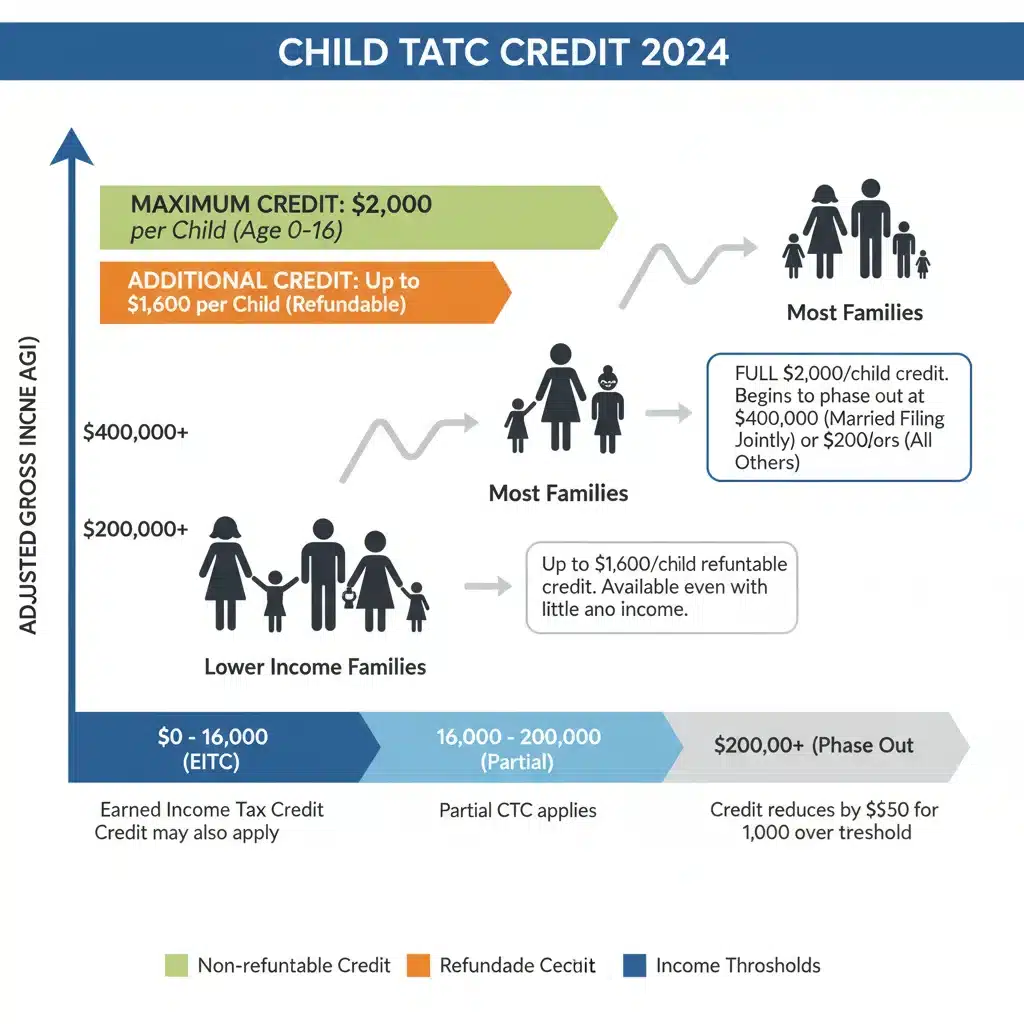
Currently, the maximum credit is $2,000 per qualifying child, with up to $1,600 of that being refundable. A refundable credit means that if the credit amount exceeds your tax liability, you could receive the difference as a refund. This feature is particularly beneficial for lower-income families who might owe little to no federal income tax. The age limit for a qualifying child is generally under 17 at the end of the tax year.
Navigating the complexities of tax law can be daunting, but being informed is the first step towards securing your family’s financial well-being. This article will break down the essential components of the Child Tax Credit 2026, offering actionable insights and answers to your most pressing questions.
Understanding the Basics: Eligibility for the Child Tax Credit 2026
To claim the Child Tax Credit 2026, several key criteria must be met for both the child and the taxpayer. It’s crucial to understand these requirements to determine your family’s eligibility.
Qualifying Child Requirements:
- Age: The child must be under the age of 17 at the end of the tax year (December 31, 2026).
- Relationship: The child must be your son, daughter, stepchild, foster child, brother, sister, half-brother, half-sister, stepbrother, stepsister, or a descendant of any of them (e.g., a grandchild, niece, or nephew).
- Residency: The child must have lived with you for more than half of the tax year in the United States. Temporary absences due to special circumstances (like illness, education, business, vacation, or military service) are generally counted as time lived at home.
- Support: The child must not have provided more than half of their own support for the year.
- Joint Return: The child cannot file a joint return for the year unless filed only to claim a refund of withheld income tax or estimated tax paid.
- Citizenship: The child must be a U.S. citizen, U.S. national, or U.S. resident alien.
Taxpayer Requirements:
- Income Thresholds: The credit begins to phase out at certain income levels. For 2026, these are expected to revert to $200,000 for single filers and $400,000 for married couples filing jointly. We’ll explore these thresholds in more detail shortly.
- Tax ID Number: Both you and your child must have a valid Social Security Number (SSN) or an Individual Taxpayer Identification Number (ITIN). For the refundable portion of the credit, the child generally needs an SSN.
It’s important to note that if you are claiming other dependents who do not meet the qualifying child criteria for the CTC, you might be able to claim the Credit for Other Dependents, which is a non-refundable credit of up to $500 per qualifying person.
Income Thresholds and Phase-Out Rules for Child Tax Credit 2026
The amount of Child Tax Credit 2026 your family receives is directly tied to your Adjusted Gross Income (AGI). The credit is not universal; it phases out for higher-income earners. Understanding these phase-out rules is crucial for calculating your potential benefit.
Under current law, for the 2026 tax year, the Child Tax Credit is expected to begin phasing out at an AGI of:
- $200,000 for single filers, heads of household, and married individuals filing separately.
- $400,000 for married couples filing jointly.
For every $1,000 (or fraction thereof) by which your AGI exceeds these thresholds, the credit amount is reduced by $50. This means that families with very high incomes may not qualify for any portion of the credit.
The Refundable Portion: Additional Child Tax Credit (ACTC)
One of the most significant aspects of the Child Tax Credit is its refundable component, known as the Additional Child Tax Credit (ACTC). For 2026, up to $1,600 of the $2,000 credit per child is refundable. This means that if your tax liability is less than the refundable portion of the credit, you could receive the difference as a tax refund, even if you owe no tax.
To qualify for the ACTC, you must have earned income above a certain threshold. For 2026, this threshold is expected to be $2,500. The refundable portion is calculated as 15% of your earned income above this threshold, up to the maximum refundable amount of $1,600 per child.
For example, if a family has $30,000 in earned income and qualifies for the full $2,000 CTC, but only owes $500 in taxes, they could still receive a refund of up to $1,500 (the $2,000 credit minus the $500 tax liability, assuming they meet the ACTC earned income requirements). If their earned income was lower, the refundable portion would be capped at 15% of their earned income above $2,500, up to $1,600.
This refundable feature is critical for low- and moderate-income families, providing a direct financial boost that can significantly impact their ability to cover essential expenses like food, housing, and childcare.
Potential Legislative Changes and Their Impact on the Child Tax Credit 2026
The landscape of tax policy is constantly shifting, and the Child Tax Credit 2026 is no exception. While current law dictates a return to the pre-American Rescue Plan (ARP) parameters, there is ongoing bipartisan discussion about expanding the credit.
The American Rescue Plan temporarily increased the CTC to $3,600 for children under six and $3,000 for children aged six to 17, made it fully refundable, and allowed for advance monthly payments. These changes significantly reduced child poverty but expired at the end of 2021.
As we approach 2026, lawmakers are debating various proposals that could:
- Increase the maximum credit amount: Pushing it beyond the current $2,000.
- Expand the refundable portion: Making more of the credit available as a refund, potentially removing or lowering the earned income threshold.
- Adjust age limits: Potentially including 17-year-olds in the higher credit tiers or extending benefits to older dependents.
- Index for inflation: Ensuring the credit’s value doesn’t erode over time due to rising costs.
Any legislative changes would require congressional agreement and presidential approval. Families should stay informed by monitoring news from the IRS and reputable financial news sources. These potential changes could significantly alter the amount your family receives, making proactive information gathering crucial.
Maximizing Your Child Tax Credit 2026: Tips and Strategies
Ensuring your family receives the maximum possible Child Tax Credit 2026 involves careful planning and accurate record-keeping. Here are some strategies and tips to help you maximize your benefits:
1. Keep Meticulous Records:
Maintain thorough records of your children’s ages, residency, and support. This includes birth certificates, school records, and documentation proving they lived with you for more than half the year. If you have shared custody, ensure you have a clear agreement on who will claim the child for tax purposes, as only one parent can claim the CTC for a particular child in a given year.
2. Understand Income Fluctuations:
Your AGI is a critical factor in determining your credit amount. If your income is close to the phase-out thresholds, consider strategies that might lower your AGI, such as contributing to a traditional IRA or 401(k), or utilizing Health Savings Account (HSA) contributions. Consult with a financial advisor to understand the implications of such decisions.
3. File Accurately and On Time:
Always file your tax return accurately and by the deadline. Errors can lead to delays or even a reduction in your credit. If you use tax preparation software, ensure all information is entered correctly. If you’re unsure, consider seeking assistance from a qualified tax professional.
4. Monitor Legislative Updates:
As discussed, the CTC is subject to potential legislative changes. Stay updated on any new laws or proposals that could impact the credit for 2026. The IRS website is an excellent resource for the most current information.
5. Claim All Eligible Dependents:
Ensure you are claiming all qualifying children. Double-check that their Social Security Numbers or ITINs are correct and that they meet all the residency and age requirements. Even if a child doesn’t qualify for the CTC, they might qualify for the Credit for Other Dependents, so explore all options.
6. Seek Professional Tax Advice:
For complex situations, such as shared custody arrangements, significant income changes, or if you’re unsure about specific eligibility criteria, consulting with a tax professional is highly recommended. They can provide personalized advice and help ensure you claim all the credits you’re entitled to.

Common Questions About the Child Tax Credit 2026 Answered
Many families have similar questions about the CTC. Here are answers to some of the most frequently asked questions regarding the Child Tax Credit 2026:
Q1: Will the Child Tax Credit be $3,600 or $3,000 per child in 2026?
A: Under current law, the Child Tax Credit is expected to revert to a maximum of $2,000 per qualifying child for 2026. The higher amounts ($3,600 and $3,000) were temporary expansions under the American Rescue Plan and expired at the end of 2021, unless new legislation is passed.
Q2: What is the age limit for a qualifying child for the 2026 CTC?
A: For the 2026 tax year, a qualifying child must be under the age of 17 at the end of the tax year (December 31, 2026). This means a child who turns 17 on or before December 31, 2026, will generally not qualify for the CTC, but might qualify for the Credit for Other Dependents.
Q3: Is the Child Tax Credit 2026 refundable?
A: Yes, a portion of the Child Tax Credit 2026 is refundable. Up to $1,600 per qualifying child is expected to be refundable as the Additional Child Tax Credit (ACTC), provided you meet the earned income threshold ($2,500 for 2026) and other eligibility criteria.
Q4: Do I need a Social Security Number for my child to claim the CTC?
A: Yes, for the Child Tax Credit, your qualifying child generally needs a valid Social Security Number (SSN) issued by the Social Security Administration. If your child has an ITIN, they may qualify for the non-refundable portion of the credit, but not the refundable ACTC.
Q5: What if I share custody of my child? Who claims the CTC?
A: Generally, only one parent can claim a child for the Child Tax Credit in a given tax year. If parents are divorced or separated, the custodial parent (the parent with whom the child lived for the greater number of nights during the year) usually claims the child. However, the custodial parent can agree to let the non-custodial parent claim the child by signing Form 8332, Release/Revocation of Release of Claim to Exemption for Child by Custodial Parent. It’s crucial to have a clear agreement to avoid issues with the IRS.
Q6: How will changes in my income affect my Child Tax Credit 2026?
A: Your Adjusted Gross Income (AGI) directly impacts the amount of CTC you receive. If your AGI exceeds the phase-out thresholds ($200,000 for single filers, $400,000 for married filing jointly), your credit will be reduced by $50 for every $1,000 over the threshold. Significant income changes could therefore reduce or eliminate your eligibility for the credit.
Q7: Can I receive the Child Tax Credit 2026 in advance monthly payments?
A: Under current law, advance monthly payments of the Child Tax Credit are not expected for 2026. This feature was part of the temporary expansion under the American Rescue Plan and has since expired. The credit will likely be claimed when you file your annual tax return.
The Broader Economic Impact of the Child Tax Credit
Beyond individual family finances, the Child Tax Credit 2026 plays a significant role in the broader economy. Studies have consistently shown that tax credits aimed at families can stimulate local economies, reduce child poverty, and improve long-term outcomes for children.
When families receive financial assistance, they are more likely to spend it on essential goods and services, such as food, clothing, and educational supplies. This increased consumer spending supports businesses and jobs within communities. Furthermore, by alleviating financial stress, the CTC allows parents to invest more in their children’s development, leading to better health, educational attainment, and future economic productivity.
Advocates for an expanded CTC often point to the success of the temporary ARP provisions in dramatically cutting child poverty rates. While the 2026 credit is expected to be more modest than the ARP version, its continued existence underscores a commitment to supporting families and recognizing the costs associated with raising children.
Preparing for Your 2026 Tax Filing
As you plan for the 2026 tax year, it’s wise to start gathering documentation early. This includes:
- Your Social Security Number (SSN) or Individual Taxpayer Identification Number (ITIN).
- Your spouse’s SSN or ITIN (if filing jointly).
- Each qualifying child’s SSN or ITIN.
- Income statements (W-2s, 1099s).
- Records of any other deductions or credits you plan to claim.
Staying organized throughout the year will make tax season much smoother and reduce the chances of errors that could impact your Child Tax Credit 2026. Consider using tax software that guides you through the process or consulting with a tax professional who can help you navigate the complexities of the tax code.
Conclusion: Staying Informed is Key for the Child Tax Credit 2026
The Child Tax Credit 2026 remains a critical component of financial support for American families, offering valuable relief to help offset the expenses of raising children. While the full $2,000 per child is the expected maximum under current law, eligibility depends on various factors, including your income, the age of your children, and their residency.
The legislative landscape is dynamic, and ongoing discussions could lead to future adjustments to the credit. Therefore, staying informed about potential changes from the IRS and legislative bodies is paramount. By understanding the eligibility requirements, income thresholds, and strategies for maximizing your benefit, you can ensure your family receives the financial support it deserves.
Don’t hesitate to utilize available resources, whether it’s the IRS website, reputable tax preparation software, or the expertise of a qualified tax professional. Proactive planning and accurate filing are your best tools for navigating the Child Tax Credit and securing your family’s financial future. The Child Tax Credit 2026 is an opportunity for significant relief, and with the right information, your family can fully benefit from it.
Author