Retirement Planning in 2026: Leveraging New IRA Contribution Limits for a 10% Wealth Boost
As we look towards 2026, the landscape of retirement planning continues to evolve, bringing with it both challenges and unprecedented opportunities. For many, the prospect of a secure and comfortable retirement hinges on astute financial decisions made today. A critical component of this planning involves understanding and strategically utilizing tax-advantaged retirement accounts, particularly Individual Retirement Arrangements (IRAs). The anticipated changes in IRA Contribution Limits for 2026 present a significant opportunity for individuals to supercharge their retirement savings, potentially leading to a remarkable 10% boost in their overall wealth accumulation. This comprehensive guide will delve into these changes, explore their implications, and provide actionable strategies to help you maximize your retirement potential.
Retirement planning is not merely about saving money; it’s about crafting a robust financial future that can withstand economic fluctuations and provide sustained comfort. The government periodically adjusts contribution limits for various retirement vehicles to account for inflation and economic growth, and 2026 is expected to bring favorable updates to IRA Contribution Limits. These adjustments are more than just numbers; they are gateways to enhanced tax benefits, accelerated growth, and ultimately, a more prosperous retirement. By understanding how to effectively leverage these new limits, you can significantly impact your long-term financial health.
Understanding the Significance of IRA Contribution Limits
IRAs are cornerstone retirement vehicles, offering tax advantages that can dramatically enhance your savings over time. Whether you choose a Traditional IRA, which offers tax-deductible contributions and tax-deferred growth, or a Roth IRA, where contributions are made with after-tax dollars but qualified withdrawals in retirement are tax-free, understanding the limits is paramount. The IRA Contribution Limits dictate the maximum amount you can contribute to these accounts annually. When these limits increase, it means you have a greater capacity to save money in a tax-advantaged environment, leading to more substantial growth.
For instance, if the IRA Contribution Limits increase by a notable margin, individuals who maximize these contributions will see a direct increase in the amount of money sheltered from immediate taxation (Traditional IRA) or tax-free growth (Roth IRA). This compounding effect, over decades, can lead to a considerable difference in your retirement nest egg. It’s not just about the extra dollars saved; it’s about the extra dollars growing without the drag of annual taxes on dividends, interest, or capital gains, depending on the IRA type.
The impact of increased IRA Contribution Limits extends beyond just the raw numbers. It provides an opportunity for individuals to re-evaluate their overall financial strategy. For those who have consistently maxed out their contributions, the new limits offer a chance to accelerate their savings further. For others who may have been struggling to meet previous limits, the psychological boost of a higher ceiling can serve as motivation to increase their savings rate. Furthermore, these changes often prompt a broader discussion about retirement readiness, encouraging individuals to engage more deeply with their financial planning.
Projected IRA Contribution Limits for 2026: What to Expect
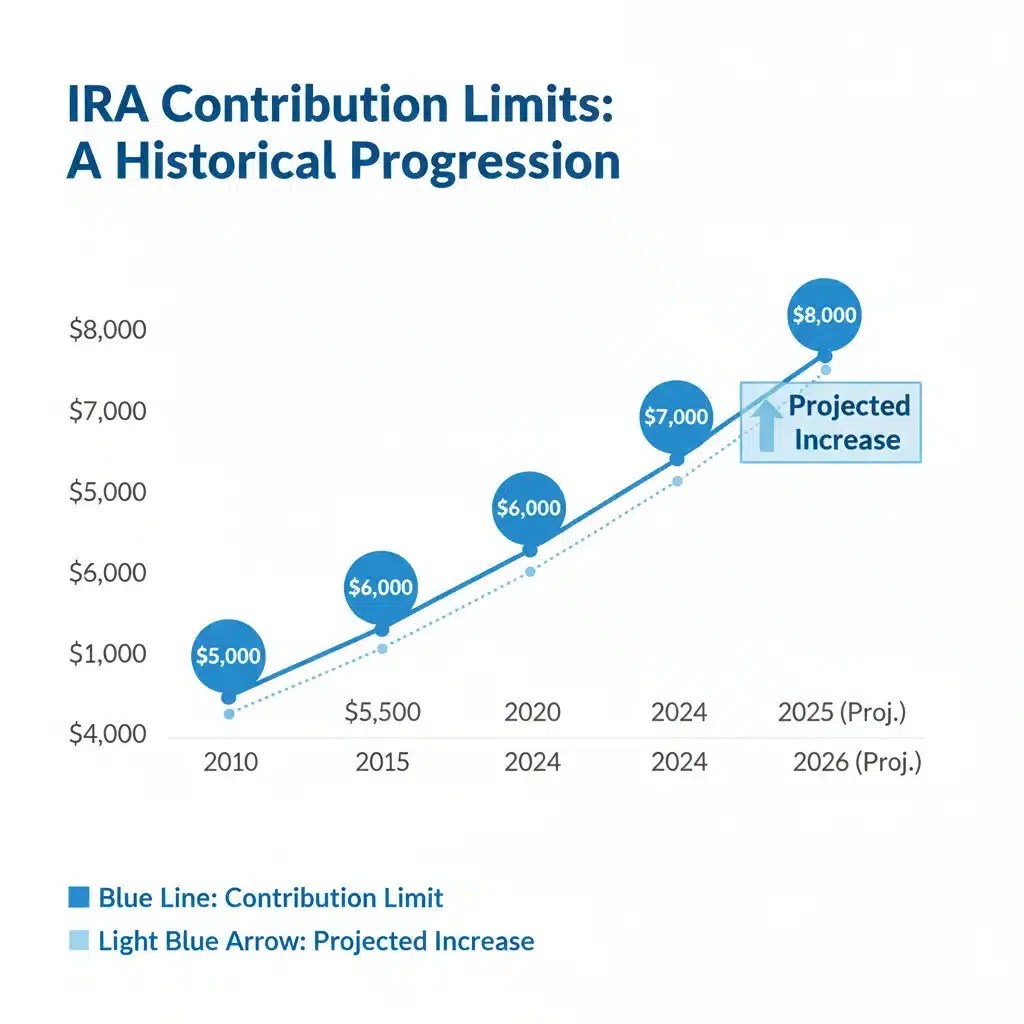
While the exact figures for 2026 IRA Contribution Limits are typically announced by the IRS in late 2025, we can make informed projections based on historical trends, inflation rates, and economic forecasts. The IRS generally adjusts these limits annually based on cost-of-living adjustments (COLAs). Given recent inflationary pressures and the overall economic climate, it is highly probable that we will see a meaningful increase. Financial experts are anticipating an increase that could allow individuals to contribute significantly more than in previous years, potentially offering that crucial 10% wealth boost we’re discussing.
For illustrative purposes, if the current IRA contribution limit for individuals under 50 is, say, $7,000, an increase of 10% would push it to $7,700. For those aged 50 and over, who benefit from catch-up contributions, a similar percentage increase on both the regular and catch-up limits would provide an even greater opportunity. These projected increases are not just theoretical; they are based on established methodologies used by the IRS to ensure that retirement savings keep pace with the cost of living and maintain their purchasing power in the future.
It’s important to monitor official IRS announcements as 2026 approaches to get the precise figures. However, proactive planning based on reasonable projections allows you to prepare your budget and investment strategy in advance. Many financial advisors already factor in anticipated increases when discussing long-term retirement plans with their clients, ensuring that their strategies are agile and adaptable to these forthcoming changes in IRA Contribution Limits. This foresight is what distinguishes effective retirement planning from reactive adjustments.
Strategies to Leverage New IRA Contribution Limits for a 10% Wealth Boost
Achieving a 10% wealth boost isn’t an arbitrary goal; it’s an achievable outcome through deliberate and strategic actions. Here’s how you can leverage the new IRA Contribution Limits in 2026:
1. Maximize Your Contributions
The most direct way to benefit is to contribute the maximum allowable amount. If you’ve been contributing less than the maximum, 2026 is the year to adjust your budget and prioritize this goal. Even a small increase in your monthly savings can add up significantly over the year, especially when compounded over time. Consider setting up automatic transfers from your checking account to your IRA each payday to ensure you consistently meet your contribution goals without having to actively think about it. This ‘set it and forget it’ approach is incredibly effective for consistent savings.
2. Understand the Power of Catch-Up Contributions
For those aged 50 and over, catch-up contributions are a powerful tool. If the regular IRA Contribution Limits increase, it’s highly likely that the catch-up contribution limit will also see an upward adjustment. This provides an even greater opportunity for older workers to make up for lost time or simply accelerate their savings in the years leading up to retirement. Don’t underestimate the impact of these additional contributions; they can be the difference between a good retirement and a great one. These extra contributions are specifically designed to help those closer to retirement shore up their savings, recognizing that they have fewer years for market growth.
3. Optimize Your IRA Choice: Roth vs. Traditional
The decision between a Roth IRA and a Traditional IRA depends on your current income, tax bracket, and anticipated future tax bracket. If you expect to be in a higher tax bracket in retirement, a Roth IRA (tax-free withdrawals) might be more advantageous. If you expect to be in a lower tax bracket in retirement, a Traditional IRA (tax-deductible contributions) could be better. The increased IRA Contribution Limits make this decision even more critical, as more money will be subject to the chosen tax treatment. Re-evaluate your tax situation and consult with a financial advisor to ensure your choice aligns with your long-term financial goals.
4. Consider Backdoor Roth IRAs
For high-income earners who exceed the income limits for direct Roth IRA contributions, the ‘backdoor Roth’ strategy remains a viable option. This involves contributing to a non-deductible Traditional IRA and then converting it to a Roth IRA. While the new IRA Contribution Limits don’t directly change the mechanics of a backdoor Roth, they do increase the amount you can move into the tax-free Roth environment, making it an even more attractive strategy for eligible individuals. It’s a perfectly legal and IRS-sanctioned method, but it requires careful execution to avoid potential tax pitfalls, especially if you have existing Traditional IRA balances.
5. Coordinate with Other Retirement Accounts (401k, 403b, etc.)
Your IRA contributions should not exist in a vacuum. Coordinate your IRA strategy with your employer-sponsored plans like 401(k)s or 403(b)s. If you’re maxing out your 401(k) and still have savings capacity, the increased IRA Contribution Limits provide an excellent avenue for additional tax-advantaged savings. Ensure you’re taking full advantage of any employer match in your 401(k) first, as that’s essentially free money. Then, strategically allocate additional savings to your IRA to diversify your retirement portfolio and maximize tax benefits across different account types.
6. Review and Adjust Your Investment Strategy
More money contributed means more money to invest. Take this opportunity to review your investment portfolio within your IRA. Is your asset allocation still appropriate for your risk tolerance and time horizon? Are you diversified enough? Consider whether you need to adjust your investment choices to align with your overall retirement goals. The increased IRA Contribution Limits give you more capital to deploy, so ensure it’s working as hard as possible for you. A well-constructed portfolio can amplify the benefits of increased contributions.
For example, if you have a long time horizon, you might consider a more growth-oriented approach, while those closer to retirement might opt for a more conservative strategy. Regularly rebalancing your portfolio is also crucial to maintain your desired risk level and capitalize on market opportunities. The influx of new funds from higher contribution limits makes this an ideal time for a thorough portfolio review.
The 10% Wealth Boost: A Realistic Expectation
The idea of a 10% wealth boost through increased IRA Contribution Limits isn’t just wishful thinking. It’s a conservative estimate of the potential impact when you combine higher savings with the power of compounding and tax advantages. Let’s consider a hypothetical scenario:
- Current Scenario (Pre-2026): An individual consistently contributes the maximum to their IRA ($7,000) for 20 years, earning an average annual return of 7%.
- 2026 Scenario (Post-2026): With a projected 10% increase in IRA Contribution Limits (to $7,700 for simplicity) and continued contributions for the remaining 19 years, the additional $700 per year, compounded, significantly adds to the total.
Even a modest increase in annual contributions, compounded over several decades, can lead to a substantial difference in your final retirement balance. The tax benefits, whether through upfront deductions or tax-free withdrawals, further amplify this growth, shielding more of your investment gains from the IRS. This 10% boost can translate into thousands, if not tens of thousands, of additional dollars in your retirement account, providing greater financial security and flexibility in your golden years.
Beyond the direct financial gain, the psychological benefit of seeing your retirement savings grow more rapidly can also be a powerful motivator. It reinforces positive financial habits and encourages continued diligent saving. This snowball effect, where increased savings lead to increased growth, which in turn motivates more saving, is a cornerstone of successful long-term financial planning.

Navigating Potential Challenges and Considerations
While the increased IRA Contribution Limits offer exciting opportunities, there are also considerations and potential challenges to navigate:
Inflationary Pressures
The very reason for increased limits (inflation) also means that your money might buy less in the future. While you’re saving more, the cost of living might also be higher. This underscores the importance of not just saving more, but also ensuring your investments are growing at a rate that outpaces inflation. Diversification and a well-thought-out investment strategy within your IRA are key to combating inflationary erosion of purchasing power.
Income Limitations for Deductibility and Roth Eligibility
Remember that income limitations can affect your ability to deduct Traditional IRA contributions or directly contribute to a Roth IRA. These income limits are also subject to annual adjustments. Always check the latest IRS guidelines to ensure you qualify for the tax benefits you’re seeking. If you’re close to or exceed these limits, strategies like the backdoor Roth or contributing to a non-deductible Traditional IRA might be necessary.
Market Volatility
Increased contributions mean more exposure to market fluctuations. While long-term investing generally smooths out volatility, it’s crucial to have a diversified portfolio that aligns with your risk tolerance. Don’t let short-term market dips deter you from consistent contributions; time in the market is often more important than timing the market.
Liquidity Needs
IRA funds are generally intended for retirement and come with penalties for early withdrawal (before age 59½). Ensure you have adequate emergency savings outside of your IRA to cover unforeseen expenses, so you don’t have to tap into your retirement funds prematurely. This financial buffer is essential for maintaining the integrity of your long-term retirement plan.
The Broader Impact: Why Increased IRA Limits Matter
The adjustment of IRA Contribution Limits is more than just a technical update; it reflects a broader commitment to encouraging individual savings and financial independence. In an era where traditional pension plans are becoming rarer, the onus is increasingly on individuals to fund their own retirements. By providing higher limits for tax-advantaged accounts, the government empowers citizens to take greater control over their financial futures.
For the economy, increased retirement savings can lead to greater capital formation, which can be invested in businesses and infrastructure, fostering economic growth. For individuals, it means more resources to draw upon in retirement, reducing reliance on social safety nets and providing greater dignity and choice in their later years. It’s a win-win scenario that benefits both individuals and the broader economic landscape.
Moreover, these adjustments serve as a regular reminder for individuals to review their financial health. Each year, when the IRS announces new limits, it prompts articles, discussions, and personal introspection about savings habits. This continuous dialogue is vital for maintaining financial literacy and encouraging proactive planning, ensuring that more people are prepared for their retirement journey.
Conclusion: Seizing the Opportunity in 2026
The anticipated increases in IRA Contribution Limits for 2026 represent a golden opportunity for anyone serious about retirement planning. By understanding these changes, implementing strategic contribution methods, and optimizing your investment approach, you can significantly enhance your retirement savings. The potential for a 10% wealth boost is not just a figure; it’s a testament to the power of consistent saving, smart investing, and leveraging tax-advantaged accounts.
Don’t wait until the last minute to adjust your strategy. Start planning now, consult with a qualified financial advisor, and prepare to maximize your contributions to take full advantage of the new IRA Contribution Limits. Your future self will thank you for the proactive steps you take today to build a secure and prosperous retirement. Embrace the changes, make informed decisions, and set yourself on a path towards unparalleled financial freedom.
The journey to a comfortable retirement is a marathon, not a sprint. Each strategic decision, especially those related to maximizing tax-advantaged accounts like IRAs, contributes significantly to reaching the finish line with confidence. Let 2026 be the year you truly accelerate your retirement savings and secure the future you’ve always envisioned.