Welcome to 2026, where the digital landscape continues to evolve at an unprecedented pace! If you’ve been hearing whispers about ‘smart contracts’ and feeling a bit lost, you’re in the right place. This comprehensive guide is designed to break down the fundamental concepts of smart contracts basics, making them accessible to absolute beginners. By the end of this article, you’ll not only understand what smart contracts are but also appreciate their revolutionary potential and why they are becoming an indispensable part of our digital future.
Imagine a world where agreements are self-executing, tamper-proof, and don’t require intermediaries to enforce them. This isn’t science fiction; it’s the reality brought forth by smart contracts. Often touted as the ‘next big thing’ after blockchain itself, smart contracts are poised to redefine how we conduct transactions, manage assets, and even govern organizations.
What Exactly Are Smart Contracts? Understanding the Core Concept
At its heart, a smart contract is simply a piece of code stored on a blockchain that automatically executes when predetermined terms and conditions are met. Think of it as a traditional contract, but digitized and automated. Instead of relying on lawyers, banks, or other third parties to ensure compliance, the contract’s execution is handled by the underlying blockchain network.
The concept of smart contracts isn’t new; it was first proposed by cryptographer Nick Szabo in 1994, long before Bitcoin or Ethereum existed. Szabo envisioned self-executing digital agreements that could reduce fraud and transaction costs. However, it wasn’t until the advent of blockchain technology, particularly with the launch of Ethereum in 2015, that smart contracts truly became a practical reality.
The ‘smart’ in smart contracts refers to their ability to automatically enforce, manage, and facilitate the negotiation of an agreement. They are immutable, meaning once deployed on the blockchain, they cannot be changed. This immutability, combined with the transparency and security of blockchain technology, makes them incredibly powerful and trustworthy.
Key Characteristics of Smart Contracts
- Self-Executing: Once conditions are met, the contract automatically executes its terms without human intervention.
- Immutable: After deployment, the code cannot be altered, ensuring the agreement’s integrity.
- Transparent: All transactions and contract code are visible on the blockchain (though participant identities can remain pseudonymous).
- Decentralized: They operate on a distributed network, eliminating the need for a central authority.
- Secure: Protected by the cryptographic principles of blockchain, making them highly resistant to tampering and fraud.
Understanding these smart contracts basics is crucial because they underpin many of the exciting developments in the digital economy today, from decentralized finance (DeFi) to non-fungible tokens (NFTs) and beyond.
How Do Smart Contracts Work? A Step-by-Step Breakdown
To truly grasp the power of smart contracts, it’s essential to understand their operational mechanics. Let’s break down the process step by step:
1. Agreement and Coding
First, parties agree on the terms and conditions of a contract. These terms are then translated into code, typically using a programming language like Solidity for the Ethereum blockchain. This code defines the rules, conditions, and actions that will take place.
2. Deployment to the Blockchain
Once coded, the smart contract is deployed to a blockchain network. This deployment records the contract on the distributed ledger, making it immutable and transparent to all participants on the network. Each node on the network stores a copy of the contract.
3. Monitoring for Conditions
The smart contract continuously monitors for the fulfillment of its predefined conditions. These conditions can be anything from a specific date passing, a payment being received, an external data feed (like a stock price or weather condition) reaching a certain value, or goods being delivered.
This is where ‘oracles’ often come into play. Oracles are third-party services that provide external data to smart contracts, as blockchains themselves cannot directly access off-chain information. They act as bridges between the real world and the blockchain.
4. Automatic Execution
When all the specified conditions are met, the smart contract automatically executes the agreed-upon actions. This could involve releasing funds, transferring ownership of an asset, sending notifications, or triggering another smart contract. No human intervention is required, and the execution is guaranteed by the blockchain’s consensus mechanism.
5. Immutable Record
The execution of the contract and the resulting actions are recorded on the blockchain, creating an unchangeable and verifiable audit trail. This provides an unprecedented level of transparency and trust, as all parties can independently verify that the contract was executed as agreed.
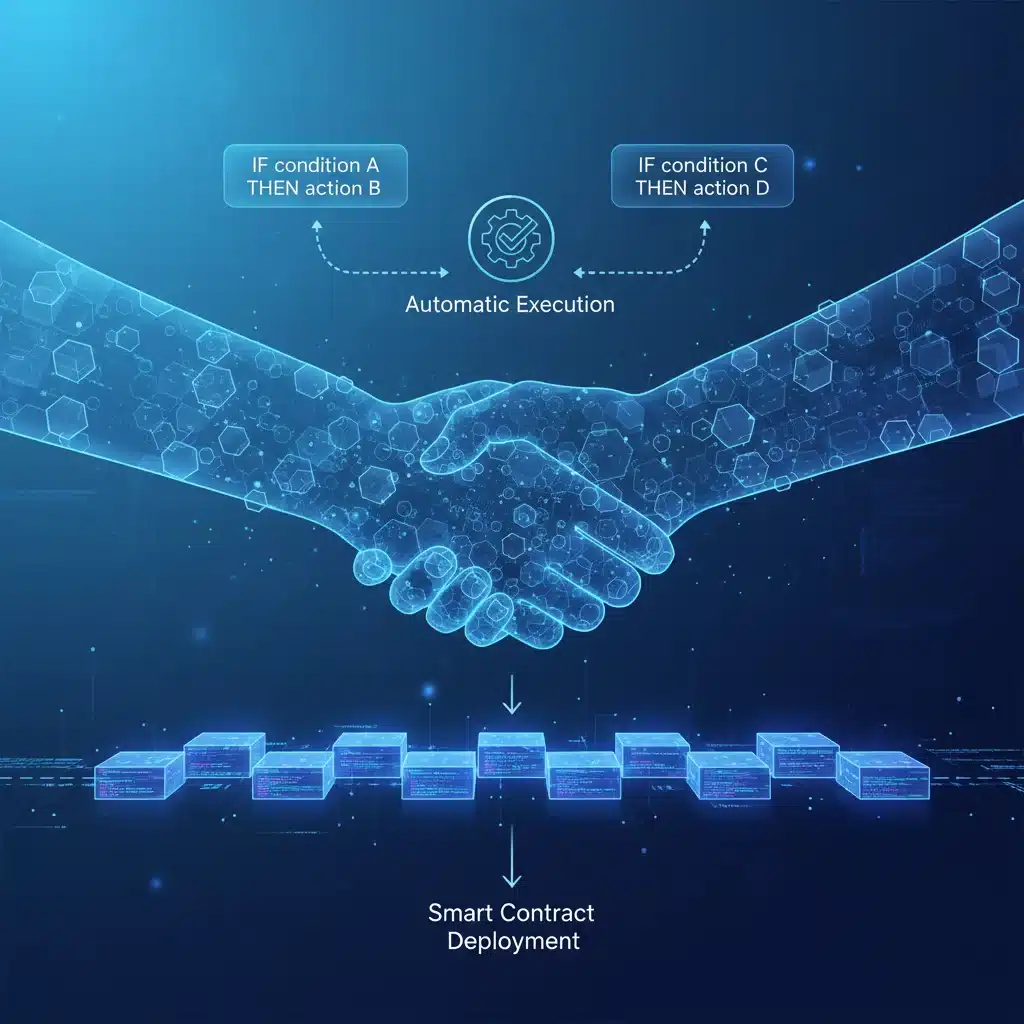
Consider a simple example: a vending machine. You put in money (condition), select a drink (another condition), and the machine automatically dispenses the drink (action). If the conditions aren’t met (e.g., not enough money), the action isn’t performed. A smart contract works on a similar ‘if-then’ logic, but on a digital, decentralized, and much more complex scale.
The Underlying Technology: Blockchain and Smart Contracts
Smart contracts are inextricably linked to blockchain technology. Without a decentralized, secure, and immutable ledger, smart contracts wouldn’t be able to achieve their full potential for trustlessness and autonomy. The blockchain provides the perfect environment for smart contracts to thrive:
- Decentralization: No single entity controls the network, preventing censorship or manipulation of the contract.
- Immutability: Once a contract is deployed and transactions occur, they cannot be reversed or altered, ensuring finality.
- Security: Cryptographic hashing and consensus mechanisms make the blockchain highly secure against attacks.
- Transparency: All participants can view the contract code and its execution history, fostering trust.
While Ethereum is the most well-known platform for smart contracts, many other blockchains now support them, including Binance Smart Chain, Solana, Cardano, and Avalanche, each offering different advantages in terms of speed, cost, and scalability. The choice of blockchain often depends on the specific requirements of the smart contract application.
Real-World Applications of Smart Contracts in 2026
The theoretical benefits of smart contracts are compelling, but their real impact is best understood through their diverse applications. In 2026, smart contracts are no longer a niche concept; they are actively transforming numerous industries.
Decentralized Finance (DeFi)
DeFi is arguably the most prominent application of smart contracts. It aims to recreate traditional financial services (lending, borrowing, trading, insurance) on a blockchain, removing intermediaries. Smart contracts automate these processes:
- Lending & Borrowing: Platforms like Aave or Compound use smart contracts to automatically match lenders and borrowers, manage collateral, and distribute interest.
- Decentralized Exchanges (DEXs): Uniswap and PancakeSwap use smart contracts to facilitate peer-to-peer token swaps without an order book or central authority.
- Stablecoins: Algorithmic stablecoins rely on smart contracts to maintain their peg to fiat currencies.
Supply Chain Management
Smart contracts can bring unprecedented transparency and efficiency to supply chains. They can automatically trigger payments upon delivery confirmation, verify product authenticity, and track goods from origin to destination. This reduces fraud, speeds up logistics, and provides real-time visibility.
Real Estate
The buying and selling of property involve numerous intermediaries and complex paperwork. Smart contracts can streamline this by automating title transfers, escrow services, and even mortgage payments, reducing costs and transaction times. Fractional ownership of real estate through tokenization is also becoming more common.
Insurance
Parametric insurance, where payouts are triggered by specific, verifiable events (e.g., a certain amount of rainfall for crop insurance, or flight delays), is a perfect use case for smart contracts. This automates claims processing, making it faster and more transparent, eliminating disputes.
Healthcare
Smart contracts can securely manage patient records, ensuring data privacy while allowing authorized access. They can also automate payments between healthcare providers and insurers, and even manage clinical trial data with enhanced integrity.
Intellectual Property & Royalties
Artists, musicians, and creators can use smart contracts to automatically distribute royalties to all contributors every time their work is used or sold. This ensures fair compensation and eliminates the need for complex rights management organizations.
Voting Systems
While still in early stages, smart contracts offer the potential for transparent, secure, and tamper-proof voting systems, enhancing electoral integrity and public trust.

These are just a few examples, and as the technology matures and regulatory frameworks adapt, the scope of smart contracts basics applications will undoubtedly expand even further.
Advantages and Disadvantages of Smart Contracts
Like any powerful technology, smart contracts come with a set of distinct advantages and some challenges that need to be addressed.
Advantages:
- Efficiency and Speed: Automation eliminates manual processes, significantly speeding up transactions and agreements.
- Trust and Transparency: The immutable and transparent nature of blockchain fosters trust among parties, as everyone can verify the terms and execution.
- Security: Cryptography protects smart contracts from tampering and fraud, making them highly secure.
- Cost Reduction: Eliminating intermediaries (lawyers, banks, brokers) can lead to substantial cost savings.
- Accuracy: Automation reduces the risk of human error in contract execution.
- Autonomy: Parties retain control over their agreements without needing a central authority.
Disadvantages:
- Immutability: While an advantage for security, it can be a disadvantage if there’s a bug in the code or a need to change terms after deployment. Correcting errors can be extremely difficult or impossible.
- Coding Errors: Smart contracts are code, and code can have bugs. A single vulnerability can lead to significant financial losses (e.g., the infamous DAO hack). Rigorous auditing is essential.
- Legal Ambiguity: The legal enforceability of smart contracts is still evolving in many jurisdictions. How they interact with traditional legal systems is a complex area.
- Scalability: Some blockchain networks struggle with scalability, which can lead to high transaction fees and slow processing times, especially during periods of high demand.
- Oracles: Reliance on external data (oracles) introduces a potential point of centralization or vulnerability if the oracle feed is compromised or inaccurate.
- Complexity: Designing and deploying secure and efficient smart contracts requires specialized technical expertise.
Understanding these trade-offs is crucial for anyone looking to leverage smart contracts basics in their projects or businesses.
The Future of Smart Contracts: What to Expect Beyond 2026
The trajectory of smart contract development suggests an exciting and transformative future. As we move further into 2026 and beyond, several key trends are likely to shape their evolution:
Increased Interoperability
Currently, many smart contracts are confined to their specific blockchain ecosystems. The future will see greater interoperability, allowing smart contracts on different blockchains to communicate and interact seamlessly. Projects focusing on cross-chain bridges and multi-chain solutions will drive this.
Enhanced Security and Auditing Tools
The industry is continuously developing more sophisticated tools for auditing and formally verifying smart contract code, reducing the risk of vulnerabilities and hacks. AI-powered auditing tools might become standard practice.
Simplified Development and User Experience
While coding smart contracts is currently complex, efforts are underway to create more user-friendly development environments, low-code/no-code platforms, and standardized templates. This will lower the barrier to entry and accelerate adoption.
Broader Regulatory Clarity
Governments and regulatory bodies worldwide are working to establish clearer legal frameworks for digital assets and smart contracts. This clarity will foster greater institutional adoption and provide a more stable environment for innovation.
Integration with Web3 and Metaverse
Smart contracts will be fundamental to the functionality of Web3 applications and the metaverse, enabling ownership of digital assets (NFTs), governing virtual economies, and facilitating decentralized interactions within virtual worlds.
Decentralized Autonomous Organizations (DAOs)
DAOs, which are organizations governed by smart contracts and their community members, will become more prevalent. They offer a new paradigm for collective decision-making and resource management, moving away from traditional hierarchical structures.
The journey of smart contracts is still relatively young, but their foundational role in building a more efficient, transparent, and decentralized digital world is undeniable. Mastering the smart contracts basics today positions you at the forefront of this technological revolution.
Getting Started with Smart Contracts: Resources for Beginners
If this introduction has piqued your interest and you’re eager to dive deeper into smart contracts, here are some pathways for beginners:
- Learn Solidity: For Ethereum-based smart contracts, Solidity is the primary programming language. Websites like CryptoZombies offer interactive tutorials that teach Solidity through building games.
- Explore Blockchain Platforms: Familiarize yourself with different blockchain ecosystems (Ethereum, Polygon, Solana, Avalanche) and their respective smart contract capabilities.
- Read Documentation: Official documentation from platforms like Ethereum.org provides in-depth technical details and guides.
- Follow Industry News: Stay updated with the latest developments in the blockchain and smart contract space through reputable crypto news outlets and communities.
- Join Online Communities: Engage with developers and enthusiasts on platforms like Discord, Reddit, and Telegram to ask questions and learn from others.
- Consider Online Courses: Many platforms offer comprehensive courses on blockchain development and smart contracts, ranging from beginner to advanced levels.
Starting with the smart contracts basics and gradually building your knowledge is the best approach. The learning curve can be steep, but the rewards of understanding and potentially contributing to this transformative technology are immense.
Conclusion: Embracing the Smart Contract Revolution
In summary, smart contracts are self-executing, tamper-proof digital agreements stored and executed on a blockchain. They operate on ‘if-then’ logic, automating transactions and processes without the need for intermediaries. From revolutionizing finance with DeFi to streamlining supply chains and enhancing transparency in various industries, their applications are vast and growing.
While challenges like code security and regulatory clarity persist, the continuous innovation in the blockchain space promises a future where smart contracts are even more secure, scalable, and user-friendly. Understanding the smart contracts basics is no longer just for tech enthusiasts; it’s becoming a fundamental literacy for navigating the increasingly digital and decentralized world of 2026 and beyond.
The power of smart contracts lies in their ability to create trust in trustless environments, reduce costs, and accelerate the pace of digital interactions. As you continue your journey in understanding this fascinating technology, remember that you are witnessing – and can be a part of – a fundamental shift in how agreements are made and enforced globally. The future is here, and it’s powered by smart contracts.